- Take a Rest vs Have a Rest: What Is the Difference?
- What Does “Take a Rest” Mean?
- What Does “Have a Rest” Mean?
- Take a Rest vs Have a Rest: Which One Should You Use?
- What Does “Get Some Rest” Mean?
- Take a Rest Meaning vs Get Some Rest
- Is “Have Some Rest” Correct?
- “Take a Rest” vs “Take a Break”
- “Have a Rest” vs “Get Some Rest”
- Common Ways to Talk About Rest
- Common Mistakes to Avoid
- Examples: Which Phrase Sounds Best?
- Frequently Asked Questions
- Conclusion: Take a Rest or Have a Rest?
If you need a break, you might say, “I need to take a rest,” or perhaps, “I need to have a rest.” Both expressions can be understood, but they do not sound equally natural in every variety of English.
So, when should you say take a rest, have a rest, or get some rest? The answer depends partly on regional English and partly on the context. This guide explains the differences clearly, with examples you can actually use.
Take a Rest vs Have a Rest: What Is the Difference?
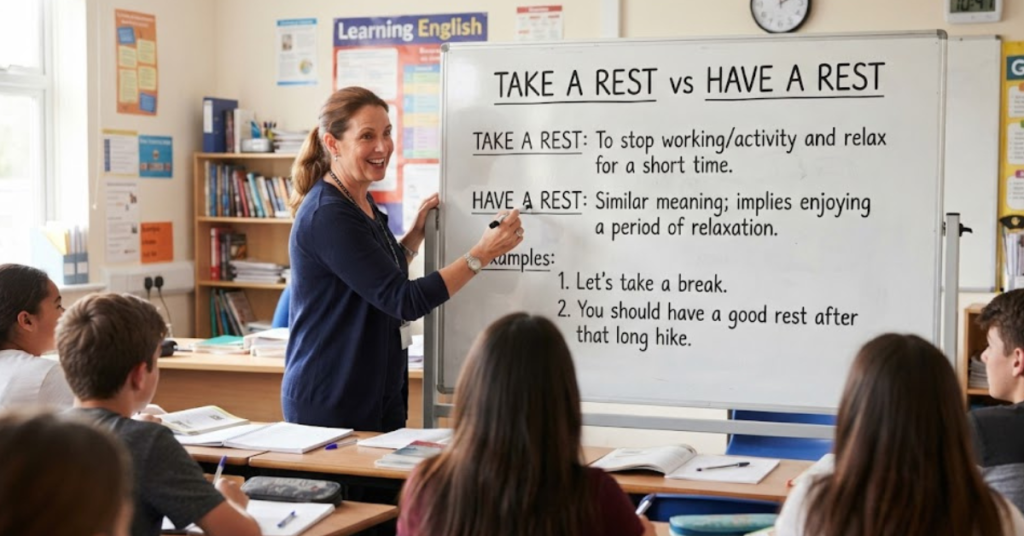
Both take a rest and have a rest mean to stop an activity temporarily so you can relax or recover your energy.
However, have a rest is particularly common in British English, while take a rest is more familiar in American English, although it can be understood in both varieties.
For example:
- British English: “You look tired. Have a rest.”
- American English: “You look tired. Take a rest.”
Neither expression is inherently wrong. The choice often comes down to the variety of English you’re using and the context.
Quick comparison
| Expression | Meaning | Typical use |
| Take a rest | Stop and rest for a while | Common, especially in American English |
| Have a rest | Stop and rest for a while | Very common in British English |
| Get some rest | Rest or sleep enough to recover | Very natural and widely used |
| Have some rest | Spend some time resting | Understandable, but less natural in some contexts |
What Does “Take a Rest” Mean?
Take a rest means to stop what you’re doing and spend some time relaxing or recovering.
It is often used when someone has become tired after physical activity.
For example:
- “You’ve been working for three hours. Take a rest.”
- “I need to take a rest before we continue hiking.”
- “She took a short rest after exercising.”
- “If you’re feeling tired, take a rest.”
The expression focuses on pausing an activity.
Is “Take a Rest” Correct English?
Yes. Take a rest is grammatically correct English.
However, native speakers may often choose take a break, get some rest, or simply rest, depending on the situation.
For example:
“I’m exhausted. I need to get some rest.”
sounds very natural.
You could also say:
“I’m exhausted. I need to take a break.”
Both are common alternatives.
What Does “Have a Rest” Mean?
Have a rest means to spend some time relaxing or recovering from tiredness.
It is especially common in British English.
For example:
- “You’ve been working all morning. Have a rest.”
- “Let’s have a rest before we walk any farther.”
- “Go upstairs and have a rest.”
- “You should have a rest if you’re feeling tired.”
The phrase is completely natural in British English and is often used when suggesting that someone stop and relax.
“Have a Rest” in British English
If you’re learning British English, have a rest is a useful everyday expression.
British English frequently uses have with activities and experiences:
- have a rest
- have a break
- have a shower
- have a chat
- have a look
This is one reason “have a rest” feels particularly natural in British speech.
Take a Rest vs Have a Rest: Which One Should You Use?
If you’re wondering which expression to choose, consider your audience.
Use “take a rest” when:
- You’re using American English.
- You’re talking about stopping physical activity.
- You want to emphasize taking time away from an activity.
Example:
“We’ve been walking for hours. Let’s take a rest.”
Use “have a rest” when:
- You’re using British English.
- You’re speaking to someone who needs to relax.
- You’re making a casual suggestion to stop and recover.
Example:
“You’ve been on your feet all day. Have a rest.”
Both are understandable internationally.
What Does “Get Some Rest” Mean?
Get some rest means to spend enough time relaxing or sleeping so that you can recover from tiredness.
It is one of the most natural and widely used expressions in everyday English.
For example:
“You look exhausted. You should get some rest.”
It doesn’t necessarily mean taking a short break. Depending on the context, get some rest can refer to sleeping, relaxing, or simply taking time away from demanding activities.
Get Some Rest Meaning in Different Situations
Consider these examples:
After a busy day:
“I’m going home to get some rest.”
Here, the speaker probably means relaxing or sleeping.
When someone is sick:
“You need to get some rest.”
This usually means resting and possibly sleeping to give the body time to recover.
Before an important event:
“Make sure you get some rest tonight.”
This often means getting enough sleep.
Take a Rest Meaning vs Get Some Rest
Although these phrases overlap, there is a subtle difference.
Take a rest usually suggests a deliberate pause.
“Let’s take a rest before climbing the hill.”
Get some rest has a broader meaning.
“You should get some rest before tomorrow’s exam.”
The first focuses on stopping for a break. The second focuses more on recovering energy, often through sleep or relaxation.
Is “Have Some Rest” Correct?
Yes, have some rest is grammatically possible and understandable.
For example:
“You’ve worked hard today. Have some rest.”
However, depending on the speaker and variety of English, have a rest or get some rest may sound more natural.
Compare:
- “Have a rest.” — very natural in British English
- “Get some rest.” — very natural across many varieties of English
- “Have some rest.” — correct, but less common in some contexts
The word some emphasizes an unspecified amount of rest.
“Take a Rest” vs “Take a Break”
These expressions are similar, but they aren’t always interchangeable.
Take a break generally means stopping an activity temporarily.
“Let’s take a break from studying.”
Take a rest puts more emphasis on recovering from physical or mental tiredness.
“You’ve been running for an hour. Take a rest.”
In everyday conversation, however, people often use take a break more broadly.
“Have a Rest” vs “Get Some Rest”
These expressions can also overlap.
Have a rest usually refers to spending a period of time resting.
“Sit down and have a rest.”
Get some rest can refer to rest or sleep.
“Go home and get some rest.”
This makes get some rest especially useful when someone is exhausted, sick, or hasn’t slept enough.
Common Ways to Talk About Rest
English has several natural expressions for resting.
1. Take a rest
“Let’s take a rest.”
2. Have a rest
“You should have a rest.”
3. Get some rest
“You need to get some rest.”
4. Take a break
“Let’s take a short break.”
5. Get some sleep
“You should get some sleep tonight.”
6. Rest for a while
“Sit down and rest for a while.”
Choosing the right expression depends on whether you’re talking about a short break, general recovery, or sleep.
Common Mistakes to Avoid
Mistake 1: Assuming only one phrase is correct
It’s not accurate to say that take a rest is always correct and have a rest is always wrong, or vice versa.
Both exist in standard English.
Mistake 2: Ignoring regional differences
British and American English sometimes prefer different everyday expressions.
Have a rest is especially associated with British English, while take a rest is widely understood and commonly used in American English.
Mistake 3: Using “get some rest” only for sleep
Getting rest can include sleep, but it can also mean relaxing or taking time away from demanding activity.
The exact meaning depends on context.
Examples: Which Phrase Sounds Best?
Here are some everyday situations:
After exercising:
“You’ve been running for an hour. Have a rest.”
Before an exam:
“You’ve studied enough. Get some rest.”
During a hike:
“Let’s take a rest before we continue.”
During work:
“Let’s take a break and get some coffee.”
After a long day:
“I’m going home to get some rest.”
Each expression works naturally in its appropriate context.
Frequently Asked Questions
Is “take a rest” correct English?
Yes. Take a rest is correct English and means to stop an activity and rest for a while.
Is “have a rest” correct English?
Yes. Have a rest is correct and particularly common in British English.
Is “take a rest” or “have a rest” more natural?
It depends on the variety of English. Have a rest is especially natural in British English, while take a rest is commonly understood and used in American English.
What does “get some rest” mean?
Get some rest means to spend time relaxing or sleeping so you can recover your energy.
Is “have some rest” grammatically correct?
Yes. Have some rest is grammatically correct and understandable, although have a rest or get some rest may sound more natural depending on the context.
Is “take a rest” the same as “take a break”?
They are similar but not identical. Take a break usually means temporarily stopping an activity, while take a rest more strongly suggests recovering from tiredness.
Should I say “get some rest” or “get some sleep”?
Use get some sleep when you specifically mean sleeping. Get some rest is broader and can include both sleeping and relaxing.
Can “have a rest” mean sleep?
It can, depending on the context, but it usually means spending time resting rather than specifically sleeping.
Conclusion: Take a Rest or Have a Rest?
So, which should you use: take a rest or have a rest?
The answer is that both are correct. Have a rest is particularly common in British English, while take a rest is also standard and widely understood, especially in American English.
If you want an expression that works naturally in a wide range of situations, get some rest is another excellent choice. It can refer to relaxing, recovering, or sleeping, depending on the context.
The key is to choose the phrase that matches your intended meaning and the variety of English you’re using. And if you’ve been reading for a while, perhaps it’s time to take a rest—or, in British English, have a rest!