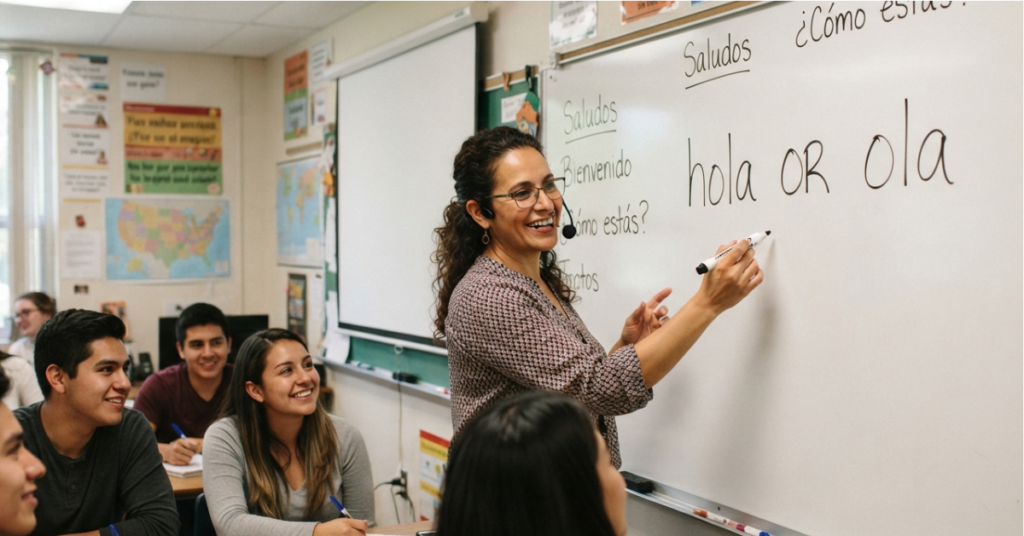
- Hola or Ola: Which One Is Correct?
- What Does Hola Mean?
- What Does Ola Mean in Spanish?
- Hola Meaning in Spanish
- Hola Which Country Language Is It?
- Hola or Ola in Spanish
- Why Do Hola and Ola Sound the Same?
- Hola vs Ola Pronunciation
- Is Ola Spanish for Hello?
- Is Olá the Same as Hola?
- Hola Meaning in Hindi
- Hola Meaning in English
- Is Hola Formal or Informal?
- How to Use Hola in a Sentence
- How to Use Ola in a Spanish Sentence
- Hola or Ola: Examples Side by Side
- Is Hola Used in Mexico?
- Is Hola Used in Spain?
- Is Hola Used in Latin America?
- Can English Speakers Use Hola?
- Common Mistakes With Hola and Ola
- Hola or Ola in Texting
- Why People Search “Ola Means Hello”
- Hola or Ola: A Simple Memory Trick
- Hola vs Ola vs Olá
- Frequently Asked Questions About Hola or Ola
- Conclusion: Hola or Ola?
A single letter can completely change the meaning of a word. That’s exactly what happens with hola or ola. They look almost identical and sound the same in many contexts, but they are not interchangeable in Spanish.
So, is hola or ola the correct way to say hello?
In Spanish, “hola” means “hello” or “hi.” “Ola,” without the H, means “wave,” such as a wave in the ocean. In Portuguese, however, “olá”—with an accent on the final a—does mean “hello.”
That small difference explains much of the confusion. Let’s look at hola meaning, ola meaning, pronunciation, language, country usage, and the situations where each word belongs.
Hola or Ola: Which One Is Correct?
If you want to say “hello” in Spanish, the correct spelling is:
Hola
Not:
Ola
In Spanish:
- Hola = hello / hi
- Ola = wave
The two words are pronounced alike in standard Spanish because the h in hola is silent. So although they sound the same, their meanings are completely different.
For example:
¡Hola! ¿Cómo estás?
means:
“Hello! How are you?”
But:
La ola es grande.
means:
“The wave is big.”
Adding or removing one letter changes the meaning entirely.
What Does Hola Mean?
The hola meaning is simply “hello” or “hi.”
It is one of the most familiar Spanish greetings and can be used when meeting someone, starting a conversation, answering a greeting, or beginning a message.
For example:
Hola, María.
means:
Hello, María.
You can also use it in slightly longer greetings:
- Hola, ¿cómo estás? — Hello, how are you?
- Hola, buenos días. — Hello, good morning.
- Hola, amigos. — Hello, friends.
- ¡Hola! — Hi!
Unlike some highly formal greetings, hola is flexible and everyday. It can fit casual conversations as well as ordinary polite interactions.
What Does Ola Mean in Spanish?
This is where many learners get tripped up.
In Spanish, ola means “wave.” It can refer to a physical wave in the sea or to a wave-like movement or phenomenon.
For example:
La ola es enorme.
means:
“The wave is enormous.”
You might also encounter ola when talking about surfing, beaches, storms, or waves of something spreading through a population.
For example:
Una ola de calor
means:
“A heat wave.”
So if you type “ola” instead of “hola” when trying to greet someone in Spanish, you haven’t used another spelling of hello. You’ve written a different Spanish word.
Hola Meaning in Spanish
The hola meaning in Spanish is “hello” or “hi.”
It is a standard greeting used across the Spanish-speaking world. The exact expressions people use around it can vary by country and situation, but hola itself is widely understood.
You may hear:
Hola.
or:
¡Hola!
or:
Hola, ¿qué tal?
The third example means roughly:
“Hello, how’s it going?”
The important point is that hola stays “hola” when you mean hello in Spanish.
Hola Which Country Language Is It?
A common question is “hola which country language?”
The answer is Spanish.
Spanish is spoken in Spain and throughout much of Latin America, as well as in many communities around the world. Hola is a standard Spanish greeting, so you can hear it in places such as:
- Spain
- Mexico
- Colombia
- Argentina
- Chile
- Peru
- Ecuador
- Venezuela
- Guatemala
- Cuba
And many other Spanish-speaking countries.
The pronunciation and regional expressions surrounding hola can vary slightly, but the basic greeting is widely recognized.
Hola or Ola in Spanish
When speaking Spanish, the distinction is very simple:
| Word | Spanish meaning | English meaning |
| Hola | Saludo | Hello / Hi |
| Ola | Onda del mar | Wave |
So if you’re greeting someone:
¡Hola!
If you’re talking about the sea:
La ola.
This is a classic example of two Spanish words that sound the same but have different spellings and meanings.
Why Do Hola and Ola Sound the Same?
The confusion comes partly from Spanish pronunciation.
The letter h is silent in Spanish, so hola is pronounced roughly “OH-lah.” Because ola is also pronounced “OH-lah,” the two words are homophones in Spanish: they sound alike but have different spellings and meanings.
That means you can’t always tell whether someone means hola or ola just by hearing the word.
Context tells you which word they mean.
For example, if someone walks into a room and says:
“¡Hola!”
you know they are greeting people.
If someone says:
“Mira la ola.”
they are talking about a wave.
Hola vs Ola Pronunciation
Both Spanish words are pronounced approximately:
OH-lah
The biggest difference is not pronunciation but spelling and meaning.
Hola
Spelling: H-O-L-A
Meaning: Hello
Pronunciation: OH-lah
Ola
Spelling: O-L-A
Meaning: Wave
Pronunciation: OH-lah
The silent h is therefore important when writing Spanish, even though you don’t hear it when the word is spoken.
Is Ola Spanish for Hello?
This is one of the most common mistakes.
No—“ola” is not the standard Spanish word for hello.
In Spanish, hola means hello, while ola means wave.
However, there is an important exception that explains why people sometimes see ola associated with “hello.”
In Portuguese, the word is:
Olá
with an accent on the final a.
Portuguese olá means hello or hi. Cambridge’s Portuguese-English Dictionary defines olá as a greeting.
So these three forms should be kept separate:
Spanish: hola = hello
Spanish: ola = wave
Portuguese: olá = hello
That distinction is the key to understanding the hola or ola question.
Is Olá the Same as Hola?
They have the same basic meaning when used as greetings, but they belong to different languages.
Hola is Spanish.
Olá is Portuguese.
The spelling is almost identical, but Portuguese uses an accent mark:
olá
That accent is not decorative. It is part of the Portuguese spelling.
Cambridge translates Portuguese olá as “hi” and “hello.”
So if you’re writing in Portuguese, use olá.
If you’re writing in Spanish, use hola.
Hola Meaning in Hindi
If you’re searching for hola meaning in Hindi, the closest everyday translations are:
हैलो
or:
नमस्ते
In simple terms:
Hola = Hello = नमस्ते / हैलो
The exact Hindi expression you choose depends on the situation. Namaste carries its own cultural and conversational usage, while hello is a more direct translation of the greeting.
The important point is that Spanish hola is simply a greeting.
Hola Meaning in English
In English, hola translates to:
- Hello
- Hi
- Hey
The exact translation depends on the context and tone.
For example:
¡Hola, amigo!
could naturally be translated as:
“Hi, friend!”
or:
“Hello, my friend!”
English speakers also sometimes use hola casually, especially in jokes, social media, travel-related conversations, or bilingual settings.
Is Hola Formal or Informal?
Hola is generally neutral and conversational.
It can be used in everyday situations with friends, acquaintances, coworkers, and strangers.
For example:
Hola, señor.
can be perfectly polite.
You can also make the greeting more formal by using a title or a more formal expression after hola.
In casual situations, you might simply say:
Hola.
There’s no need to make the greeting more complicated.
How to Use Hola in a Sentence
Here are some natural examples.
Greeting a friend
¡Hola, Carlos!
English: Hi, Carlos!
Meeting someone
Hola, mucho gusto.
English: Hello, nice to meet you.
Asking how someone is
Hola, ¿cómo estás?
English: Hello, how are you?
Starting a message
Hola, ¿puedes ayudarme?
English: Hi, can you help me?
Greeting a group
Hola a todos.
English: Hello, everyone.
These examples show how flexible the word is in everyday Spanish.
How to Use Ola in a Spanish Sentence
Since ola means “wave,” it belongs in sentences describing waves or wave-like phenomena.
For example:
La ola golpeó la playa.
English: The wave hit the beach.
Another example:
Hay olas enormes hoy.
English: There are huge waves today.
And:
La ola de calor duró varios días.
English: The heat wave lasted several days.
In each sentence, ola has nothing to do with saying hello.
Hola or Ola: Examples Side by Side
Seeing them together makes the difference easier to remember.
Hola
¡Hola! ¿Cómo estás?
Meaning: Hello! How are you?
Ola
La ola llegó a la orilla.
Meaning: The wave reached the shore.
Portuguese Olá
Olá! Tudo bem?
Meaning: Hello! How are you?
The spelling may look confusing, but the languages and meanings are distinct.
Is Hola Used in Mexico?
Yes.
Hola is a normal Spanish greeting in Mexico, just as it is in other Spanish-speaking countries.
You might hear:
Hola, ¿cómo estás?
or a more casual greeting such as:
¿Qué tal?
The choice of greeting can depend on the speaker, relationship, and region, but hola is a straightforward and widely understood option.
Is Hola Used in Spain?
Yes.
Hola is one of the standard everyday greetings in Spain.
A person might say:
Hola, ¿qué tal?
which means:
“Hi, how’s it going?”
You may also hear other casual greetings depending on the setting, but hola remains perfectly natural.
Is Hola Used in Latin America?
Yes.
Hola is widely used throughout Spanish-speaking Latin America.
Although regional vocabulary and pronunciation can vary, the word itself is familiar across Spanish-speaking communities.
So you generally don’t need to worry that hola works in one Spanish-speaking country but not another.
Can English Speakers Use Hola?
Absolutely.
English speakers commonly recognize hola as a Spanish greeting and sometimes use it in English conversations.
For example:
“Hola! How are you?”
This is especially common in bilingual environments and informal settings.
However, dropping Spanish words into English does not automatically make a sentence Spanish. If you’re actually writing or speaking Spanish, make sure the rest of the sentence matches the language.
Common Mistakes With Hola and Ola
Mistake 1: Writing “Ola” when you mean hello in Spanish
If you’re greeting someone in Spanish, write:
Hola
not:
Ola
Mistake 2: Assuming the silent H doesn’t matter
The H is silent when spoken, but it still matters in written Spanish.
Compare:
hola = hello
ola = wave
Mistake 3: Confusing Spanish with Portuguese
Portuguese uses:
olá
for hello.
Spanish uses:
hola
It’s an easy mix-up because the words look and sound similar.
Mistake 4: Thinking “ola” is simply a shorter version of “hola”
It isn’t.
The Spanish word ola has its own meaning: wave.
Hola or Ola in Texting
Text messages create an additional layer of confusion because people frequently leave out accents, punctuation, and sometimes even letters.
For example, a Portuguese speaker might type:
ola
instead of:
olá
in an informal message where accents are omitted.
That doesn’t necessarily mean they are writing Spanish incorrectly. It may simply reflect informal typing.
By contrast, a Spanish speaker writing ola to mean hello is spelling the Spanish greeting incorrectly.
So, as always, context matters.
Why People Search “Ola Means Hello”
There are a few reasons people encounter ola connected to “hello.”
First, Portuguese uses olá as a greeting. Cambridge confirms this usage.
Second, the Portuguese and Spanish words are visually similar:
Spanish: hola
Portuguese: olá
Third, accents are frequently dropped in casual online writing, making olá appear as ola.
That can make it look as though ola itself is a Spanish word for hello, which it isn’t.
Hola or Ola: A Simple Memory Trick
Here’s an easy way to remember the difference:
H = Hello
Think of the H in hola as a reminder that you’re saying hello.
Then remember:
Hola → Hello
Ola → Ocean wave
It isn’t a linguistic rule, but it’s a useful memory trick for learners.
For Portuguese:
Olá → Hello
The accent on the final a helps distinguish the Portuguese greeting from Spanish ola.
Hola vs Ola vs Olá
Here’s the whole issue in one table:
| Word | Language | Meaning |
| Hola | Spanish | Hello / Hi |
| Ola | Spanish | Wave |
| Olá | Portuguese | Hello / Hi |
| Ola | Portuguese | Wave |
This is the easiest comparison to save if you frequently mix up the three spellings.
Frequently Asked Questions About Hola or Ola
Is it hola or ola?
If you mean hello in Spanish, the correct spelling is hola. In Spanish, ola means wave.
What is the hola meaning?
Hola means hello or hi in Spanish.
Does ola mean hello?
Not in standard Spanish. Ola means “wave” in Spanish. In Portuguese, olá means hello.
What does ola mean in Spanish?
Ola means wave in Spanish. It can refer to an ocean wave or similar wave-like phenomena.
What is the ola meaning in Portuguese?
The Portuguese word olá, with an accent on the final a, means hello or hi.
Is hola Spanish or Portuguese?
Hola is Spanish. Portuguese uses olá as a greeting.
Hola which country language?
Hola is a Spanish word, so it is used in Spain and across Spanish-speaking countries in Latin America and elsewhere.
What is hola meaning in Hindi?
Hola means hello in English and can be translated into Hindi as हैलो or, depending on the context, नमस्ते.
Why is the H in hola silent?
Spanish h is normally silent, so hola is pronounced approximately OH-lah. That’s why hola and Spanish ola sound alike even though they are spelled differently.
Can I write “ola” instead of “hola”?
Not when you’re writing standard Spanish and mean “hello.” Use hola. Writing ola gives you the Spanish word for “wave.”
Is “Olá” the Portuguese version of “Hola”?
Yes, in terms of meaning. Portuguese olá is a greeting meaning hello or hi, while Spanish hola serves the same basic function.
Are hola and ola pronounced the same?
In standard Spanish, yes. The h in hola is silent, so hola and ola are pronounced alike.
Is hola used formally?
It is a normal, neutral greeting and can be used politely in many everyday situations. The overall level of formality depends more on the surrounding language and situation.
Conclusion: Hola or Ola?
The hola or ola confusion comes down to one silent letter—but that letter matters when you’re writing.
In Spanish, remember:
Hola = hello
Ola = wave
If you’re speaking Portuguese, the greeting is:
Olá = hello
So when someone asks “ola means hello?”, the answer depends on the language and spelling. In Spanish, ola does not mean hello. In Portuguese, olá does.
And when you’re trying to say hello in Spanish, there is one clear choice:
¡Hola!
That little H may be silent when you pronounce it, but don’t leave it out when you write it.