- Trash vs Garbage: The Main Difference
- What Is Trash?
- What Is Garbage?
- Why Are Trash and Garbage Often Used Interchangeably?
- Regional Differences
- Trash vs Garbage in Waste Management
- Common Examples
- Related Terms
- Memory Trick to Remember the Difference
- Common Mistakes to Avoid
- Frequently Asked Questions (FAQs)
- Conclusion
Have you ever wondered whether you should say trash or garbage? If you’ve traveled between different English-speaking countries—or even different parts of the United States—you’ve probably heard both terms used interchangeably. While many people treat them as synonyms, there is actually a subtle difference between them.
Understanding trash vs garbage can help you communicate more clearly, especially in professional writing, environmental discussions, or everyday conversations. In this guide, we’ll explain the meanings of both words, explore their differences, provide practical examples, and show you when it’s appropriate to use each one.
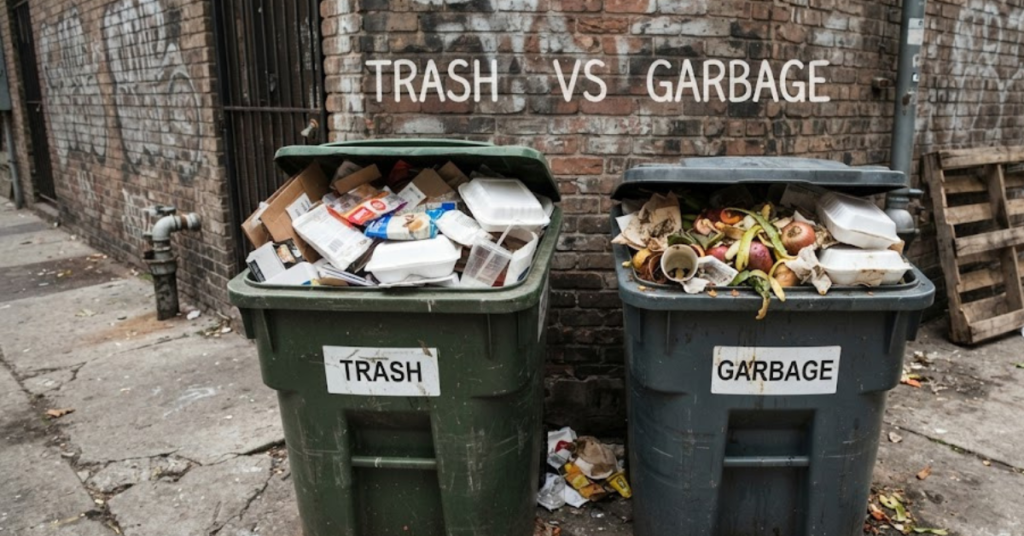
Trash vs Garbage: The Main Difference
Although the words are often used interchangeably, they traditionally refer to different types of waste.
- Trash generally refers to dry waste or non-food items that are thrown away.
- Garbage traditionally refers to food waste or organic kitchen waste.
Here’s a simple comparison:
| Word | Traditional Meaning |
| Trash | Paper, plastic, packaging, broken items, and other dry waste |
| Garbage | Food scraps, spoiled food, and organic kitchen waste |
In everyday American English, however, many people use both words to mean any type of waste.
What Is Trash?
Trash usually refers to dry materials that are no longer useful but are not necessarily food-related.
Examples include:
- Paper
- Plastic bottles
- Cardboard
- Empty packaging
- Broken toys
- Old clothing
- Disposable cups
- Aluminum cans
Example sentences:
- Please take the trash out tonight.
- The office trash bin is full.
- We separate recyclable materials from the trash.
Because trash often contains recyclable materials, waste management systems may encourage sorting it before disposal.
What Is Garbage?
Garbage traditionally refers to wet or organic household waste, particularly from kitchens.
Examples include:
- Fruit peels
- Vegetable scraps
- Leftover meals
- Coffee grounds
- Eggshells
- Expired food
Example sentences:
- The garbage should be taken out before it starts to smell.
- Food waste belongs in the garbage bin.
- Composting reduces the amount of garbage sent to landfills.
Because garbage decomposes quickly, it often requires more frequent disposal than dry trash.
Why Are Trash and Garbage Often Used Interchangeably?
In modern English—especially in North America—the distinction between trash and garbage has become less important in everyday conversation.
For example, someone might say:
- Take out the trash.
- Take out the garbage.
Both sentences are generally understood to mean disposing of household waste.
The exact term often depends on regional preference, family habits, or local dialect.
Regional Differences
Different English-speaking countries prefer different vocabulary.
United States
Both trash and garbage are common.
- “Trash” is often used for general household waste.
- “Garbage” is especially common when referring to kitchen waste.
Canada
Both words are widely understood, although usage varies by region.
United Kingdom
People are more likely to use:
- Rubbish
- Bin
- Waste
Instead of:
- Trash
- Garbage
For example:
- Take the rubbish out.
- Put it in the bin.
Australia and New Zealand
Common terms include:
- Rubbish
- Waste
- Bin
Again, trash and garbage are understood but less frequently used.
Trash vs Garbage in Waste Management
Waste management professionals often use more specific categories than everyday speakers.
These may include:
- Municipal solid waste
- Organic waste
- Recyclables
- Compost
- Yard waste
- Hazardous waste
- Electronic waste (e-waste)
In these contexts, trash and garbage may have more precise definitions depending on local regulations.
Common Examples
Trash
- Newspapers
- Plastic containers
- Packaging
- Broken furniture
- Disposable gloves
Garbage
- Banana peels
- Leftover pizza
- Vegetable scraps
- Coffee filters
- Spoiled meat
Knowing the traditional distinction can be useful, particularly when sorting waste for recycling or composting.
Related Terms
You may also encounter these similar words:
- Waste
- Refuse
- Rubbish
- Litter
- Junk
- Debris
- Scrap
- Recycling
- Compost
Although these terms overlap, each has its own specific meaning depending on the context.
Memory Trick to Remember the Difference
Here’s an easy way to remember:
Garbage grows. Trash doesn’t.
Food waste can rot, smell, and decompose.
Dry materials like paper and plastic generally do not.
Think:
- Garbage = Organic waste
- Trash = Dry waste
Even though modern usage overlaps, this memory trick helps distinguish their traditional meanings.
Common Mistakes to Avoid
Avoid assuming every English-speaking country uses the same terminology.
For example:
- Americans often say trash can.
- British speakers usually say bin.
- Americans often say garbage truck.
- British speakers typically say refuse truck or bin lorry.
Understanding regional vocabulary makes communication easier, especially when traveling.
Frequently Asked Questions (FAQs)
What is the difference between trash vs garbage?
Traditionally, trash refers to dry waste such as paper, plastic, and packaging, while garbage refers to food scraps and other organic kitchen waste.
Are trash and garbage the same thing?
In everyday American English, they are often used interchangeably. However, their traditional meanings are slightly different.
Is food waste considered trash or garbage?
Traditionally, food waste is garbage.
What is a trash can?
A trash can is a container used for collecting household waste, particularly dry waste.
What is a garbage disposal?
A garbage disposal is a kitchen appliance installed beneath a sink that grinds food waste before it enters the plumbing system.
Do British people say trash or garbage?
Not usually. In British English, people typically say rubbish, waste, or bin instead.
Which word should I use?
Either is acceptable in most American conversations. If you want to be technically precise:
- Use trash for dry waste.
- Use garbage for food or organic waste.
Conclusion
When comparing trash vs garbage, the difference is subtle but useful to understand. Traditionally, trash refers to dry, non-food waste like paper, plastic, and packaging, while garbage refers to food scraps and other organic kitchen waste. Although modern American English often uses the two terms interchangeably, knowing their original meanings can help you communicate more accurately, especially in discussions about recycling, composting, and waste management.
The next time you’re sorting household waste or writing about environmental topics, remember this simple rule: garbage is typically organic, while trash is generally dry. Understanding this distinction will improve your vocabulary, make your writing more precise, and help you use English with greater confidence.
If you found this guide helpful, explore our other vocabulary and grammar articles to discover the differences between more commonly confused English words and phrases.