- On Friday or In Friday: Which Is Correct?
- Why Do We Say “On Friday”?
- Why “In Friday” Is Incorrect
- On Friday vs In Friday Examples
- What About “At Friday”?
- On Friday Morning or In Friday Morning?
- On Friday or On Fridays?
- On Friday vs This Friday
- On Friday vs Next Friday
- The Easy Rule for At, On, and In
- Common Mistakes With “On Friday”
- Is “Friday” Without “On” Ever Correct?
- Frequently Asked Questions
- Conclusion: On Friday or In Friday?
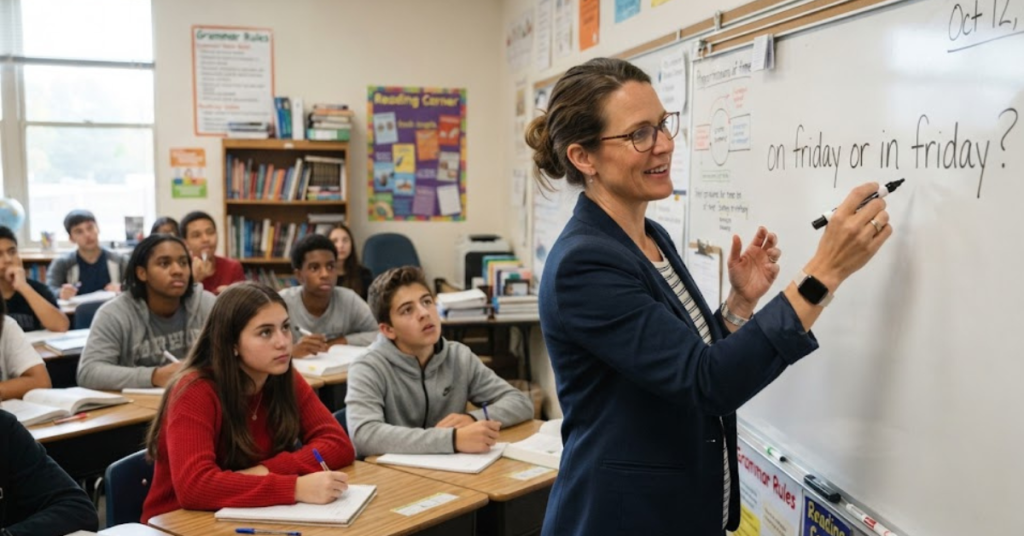
Sometimes, the smallest English words cause the biggest confusion. The question “on Friday or in Friday?” is a good example. If you’re talking about something happening on a particular day, the correct expression is “on Friday.”
English uses different prepositions for different time expressions. Once you understand the basic pattern behind at, on, and in, choosing the right one becomes much easier.
On Friday or In Friday: Which Is Correct?
The correct phrase is:
On Friday
The phrase in Friday is not standard English when referring to the day of the week.
For example:
“We have a meeting on Friday.”
Not:
“We have a meeting in Friday.”
The same rule applies to the other days of the week:
- on Monday
- on Tuesday
- on Wednesday
- on Thursday
- on Friday
- on Saturday
- on Sunday
So, if you’re wondering “on Friday or in Friday?”, remember that on is the appropriate preposition for a specific day.
Why Do We Say “On Friday”?
In English, on is commonly used with particular days and dates.
For example:
- “I’ll call you on Friday.”
- “She arrived on Friday.”
- “The exam is on Friday.”
- “We’re going shopping on Friday.”
- “The concert takes place on Friday.”
The word on connects the event to the specific day when it occurs.
This pattern also works with dates:
- on August 12
- on December 25
- on January 1
- on my birthday
- on New Year’s Day
Why “In Friday” Is Incorrect
The preposition in is normally used for broader periods of time, rather than a particular day.
For example:
- in January
- in 2026
- in winter
- in the morning
- in the 21st century
Friday is a single day, so on is used instead:
“I’ll see you on Friday.”
This distinction is one of the most useful rules to remember when learning English time prepositions.
On Friday vs In Friday Examples
Seeing the difference in real sentences makes the rule easier to remember.
Correct: On Friday
“The store opens on Friday.”
“I have a doctor’s appointment on Friday.”
“She is traveling on Friday.”
Incorrect: In Friday
“The store opens in Friday.”
“I have an appointment in Friday.”
“She is traveling in Friday.”
When Friday itself is the time reference, use on.
What About “At Friday”?
Another common question is whether you can say at Friday.
In standard English, you should say:
on Friday
rather than:
at Friday
However, at is used for specific times.
For example:
“The meeting is at 3 p.m. on Friday.”
Here, each preposition has a different job:
- at 3 p.m. → exact time
- on Friday → specific day
This is why using more than one time preposition in the same sentence is perfectly normal.
On Friday Morning or In Friday Morning?
If you’re talking about a particular Friday morning, the natural expression is:
on Friday morning
For example:
“I’ll call you on Friday morning.”
Not:
“I’ll call you in Friday morning.”
But notice the difference when there is no specific day:
“I’ll call you in the morning.”
So the general pattern is:
- in the morning → general time
- on Friday morning → specific day and part of day
The same applies to other parts of the day:
- on Friday afternoon
- on Friday evening
- on Friday night
On Friday or On Fridays?
These expressions have slightly different meanings.
On Friday
Usually refers to one particular Friday:
“I’m going to the dentist on Friday.”
On Fridays
Usually describes something that happens regularly:
“I work from home on Fridays.”
More examples:
- “We play tennis on Fridays.”
- “The restaurant is busiest on Fridays.”
- “She attends a class on Fridays.”
The -s indicates a repeated or habitual event.
On Friday vs This Friday
Both expressions are correct, but they can emphasize different things.
On Friday:
“I’ll meet you on Friday.”
This Friday:
“Are you free this Friday?”
This Friday usually points to the Friday associated with the current week or immediate context.
For casual conversations, either can sound natural depending on what you want to emphasize.
On Friday vs Next Friday
You can also say next Friday:
“The interview is next Friday.”
This normally refers to the upcoming Friday after the current point in time, although the exact interpretation can occasionally depend on context.
If there’s any possibility of confusion, especially when arranging an appointment, using the date is safest:
“The interview is on Friday, August 14.”
That removes any ambiguity.
The Easy Rule for At, On, and In
If time prepositions are confusing, start with this simple guide.
Use “at” for exact times
- at 5 p.m.
- at noon
- at midnight
- at 7:30
The Use “on” for days and dates
- on Friday
- on Monday
- on Friday morning
- on August 14
- on my birthday
Use “in” for longer periods
- in August
- in 2026
- in summer
- in the morning
- in the 1990s
There are some exceptions in English, but this rule works for a large number of everyday time expressions.
Common Mistakes With “On Friday”
1. Saying “in Friday”
Incorrect:
“The event is in Friday.”
Correct:
“The event is on Friday.”
2. Saying “at Friday”
Incorrect:
“I’ll see you at Friday.”
Correct:
“I’ll see you on Friday.”
3. Mixing up “in the morning” and “on Friday morning”
Incorrect:
“I’ll call you in Friday morning.”
Correct:
“I’ll call you on Friday morning.”
But:
“I’ll call you in the morning.”
is correct when you’re not naming a particular day.
Is “Friday” Without “On” Ever Correct?
Yes. In some varieties of English, particularly informal American English, speakers commonly omit on before a day.
For example:
“I’ll see you Friday.”
This is perfectly natural in many contexts.
However, “I’ll see you on Friday” is also completely correct and is a useful standard form for English learners.
The important point is that “in Friday” is not the standard construction.
Frequently Asked Questions
Is it “on Friday” or “in Friday”?
The correct standard expression is on Friday. Use on when referring to a specific day of the week.
Is “in Friday” grammatically correct?
No, not when you’re using it to mean that something happens on Friday. The standard expression is on Friday.
Is it “at Friday” or “on Friday”?
Use on Friday for the day. Use at for a specific time, such as at 4 p.m. on Friday.
Do we say “on Friday morning” or “in Friday morning”?
The natural expression is on Friday morning. Without a specific day, use in the morning.
Is “on Fridays” correct?
Yes. On Fridays is commonly used for repeated or habitual events.
For example:
“We have team meetings on Fridays.”
Can I say “I’ll see you?
Yes. This is common in informal English, especially American English. “I’ll see you on Friday” is also correct.
Why do we use “on” for days?
English conventionally uses on with specific days and dates, such as on Friday, on Monday, and on August 14.
Conclusion: On Friday or In Friday?
When choosing between on Friday or in Friday, the correct standard expression is on Friday.
The easiest rule to remember is:
- On → days and dates
- At → exact times
- In → months, years, seasons, and longer periods
So you would say:
“The meeting is on Friday.”
Not:
“The meeting is in Friday.”
Once you understand this simple pattern, you’ll find it much easier to use English time prepositions naturally in conversations, emails, and formal writing.