- What Is GrammarVista.com?
- Our Mission
- Our Vision
- Why Grammar Still Matters in 2026
- Practical Grammar Lessons for Everyday Communication
- English Grammar Topics We Cover
- Beyond Grammar — Writing Skills We Teach
- Learning English as a Second Language
- Learning English Made Simple
- How Our Content Gets Made
- Who Uses GrammarVista?
- Why Readers Trust GrammarVista
- Frequently Asked Questions
- Final Thoughts
If you’ve ever stared at a sentence wondering whether that comma belongs there, you’re not alone. Grammar trips up native speakers and language learners alike, and honestly? That’s okay. GrammarVista.com USA exists for exactly that reason: to give people a place to learn grammar, sharpen their writing, and communicate with confidence, without the stuffy textbook tone that makes most grammar resources feel like homework.
This article walks through what GrammarVista.com USA actually offers, why grammar still matters in an age of AI writing assistants, and how the site has built a reputation as a dependable resource for students, professionals, and English learners across the country.
What Is GrammarVista.com?
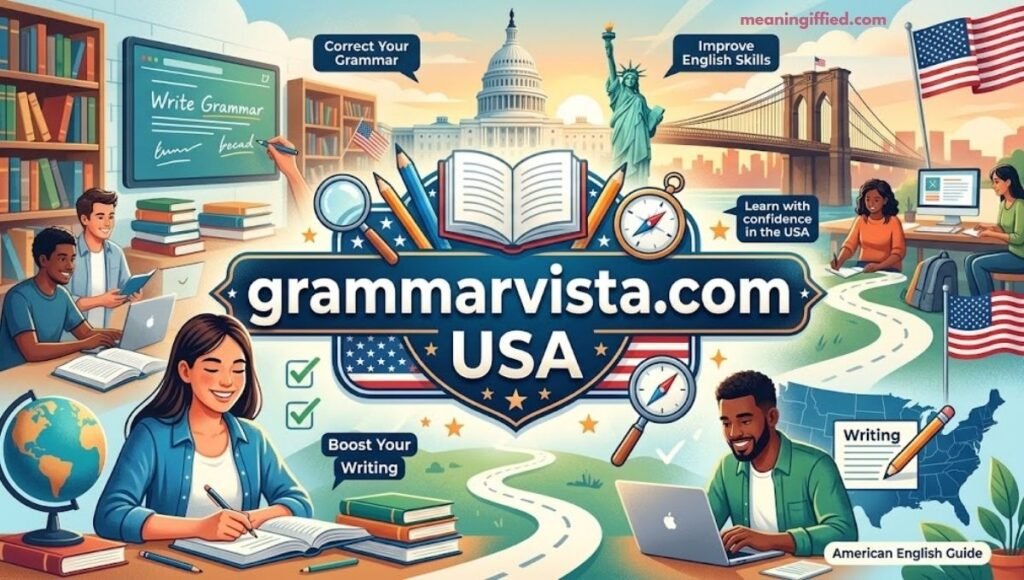
At its core, GrammarVista.com is an online educational resource focused on English grammar, writing mechanics, and language learning support. Think of it less like a dictionary and more like a patient tutor who explains things in plain English (pun intended).
The site breaks grammar topics into digestible lessons rather than overwhelming readers with dense linguistic terminology. Instead of opening with a wall of technical jargon about “subordinating conjunctions,” a typical GrammarVista lesson might start with a relatable example: “You wrote ‘me and him went to the store’—here’s why that’s wrong, and here’s the quick fix.”
What sets grammarvista.com usa apart from many competitors is its blend of accessibility and depth. Beginners get clear, jargon-free explanations. More advanced writers, meanwhile, find nuanced discussions of style, tone, and structure that go beyond basic rule-following.
In short, GrammarVista.com is:
- A grammar reference for quick answers
- A writing improvement resource for longer-term skill building
- A learning hub for ESL and EFL students
- A blog that publishes ongoing lessons and language tips
Our Mission
GrammarVista’s mission is simple to state but harder to execute well: make good English accessible to everyone, regardless of their starting point.
That means a high schooler prepping for the SAT, a small business owner writing customer emails, and a non-native speaker learning English for the first time should all be able to find something useful on the same site. Rather than assuming a baseline of grammatical knowledge, GrammarVista builds lessons from the ground up, so nobody feels lost or talked down to.
There’s also a quieter part of the mission that matters just as much: restoring confidence. A lot of people carry embarrassment around their grammar skills, sometimes from a bad experience in school or a critical comment from a boss. GrammarVista treats grammar as a skill you build, not a talent you either have or don’t.
Our Vision
Looking ahead, GrammarVista.com USA aims to become the go-to reference that people bookmark and actually return to, not just a site that shows up once in a search result and gets forgotten.
The long-term vision includes:
- Expanding lesson libraries to cover more advanced writing topics, including academic and business writing
- Building out ESL-specific learning paths for non-native speakers at different proficiency levels
- Keeping content current as language use evolves (yes, language changes constantly, whether grammar purists like it or not)
- Creating a space where readers feel comfortable asking questions instead of guessing
Growth for its own sake isn’t the goal here. The site would rather stay genuinely useful to a smaller, engaged audience than chase traffic with thin, forgettable content.
Why Grammar Still Matters in 2026
Here’s a fair question: with AI writing tools now checking spelling, fixing grammar, and even rewriting entire paragraphs, does anyone actually need to learn grammar anymore?
Yes. And here’s why.
AI tools are assistants, not substitutes for understanding. Autocorrect and grammar checkers catch a lot, but they don’t catch everything, and they definitely don’t teach you why something is wrong. If you don’t understand the underlying rule, you’ll keep making the same mistake in contexts the tool doesn’t flag, like a text message, a handwritten note, or a live conversation where there’s no software running in the background.
There’s also a credibility factor that shows up in surprisingly high-stakes situations. A 2013 CareerBuilder survey found that 58% of employers said they’d think less of a resume with typos or grammatical errors, and many said they’d reject a candidate outright over it. That’s not a small number. Grammar errors don’t just look sloppy; they can genuinely cost people job opportunities, business deals, and first impressions.
“Good grammar isn’t about being pedantic. It’s about being understood clearly, the first time, without your reader having to work for it.” — a sentiment echoed across GrammarVista’s writing philosophy
Consider a quick comparison of what strong versus weak grammar communicates to a reader, even subconsciously:
| Situation | Weak Grammar Signal | Strong Grammar Signal |
|---|---|---|
| Job application email | Rushed, careless | Professional, detail-oriented |
| Business proposal | Untrustworthy, unpolished | Credible, prepared |
| Academic essay | Lower perceived comprehension | Clear command of the subject |
| Customer service message | Unprofessional | Reliable and competent |
| Social media bio | Casual (sometimes fine) | Depends entirely on context |
Grammar isn’t about sounding fancy. It’s about removing friction between what you mean and what your reader understands. That’s the whole game.
Practical Grammar Lessons for Everyday Communication
One thing that makes GrammarVista.com USA stand out is its focus on practical, everyday grammar, not just academic rules nobody uses outside a classroom.
Lessons tend to center on real situations:
- Writing a professional email without sounding stiff or overly casual
- Texting your boss versus texting a friend (yes, grammar rules bend depending on the audience)
- Editing a college essay so it reads clearly under time pressure
- Catching subject-verb agreement errors in long, complicated sentences
Here’s a small but common example the site covers well: the difference between “who” and “whom.” Most people avoid using “whom” entirely because they’re not confident about it, which honestly works fine in casual writing. But in formal writing, GrammarVista breaks it down with a trick that sticks: if you can replace the word with “him,” use “whom.” If you can replace it with “he,” use “who.” (“Whom did you call?” → “I called him.” “Who called you?” → “He called me.”)
Small tricks like that turn abstract rules into something you can actually apply on the fly.
English Grammar Topics We Cover
GrammarVista organizes its grammar content into a few core categories, so readers can find what they need quickly instead of scrolling through unrelated posts.
Grammar Rules
This covers the structural backbone of English: parts of speech, verb tenses, sentence structure, subject-verb agreement, and how clauses fit together. It’s the foundation everything else builds on.
Common topics include:
- Present, past, and future tense usage (and their perfect and continuous forms)
- Active voice versus passive voice
- Common word confusions (affect/effect, its/it’s, then/than)
- Sentence fragments and run-ons
Punctuation
Punctuation might be the single most misunderstood area of grammar, and it’s where GrammarVista spends a lot of its energy. Commas alone cause more writing anxiety than almost anything else in the English language.
The site covers:
- Comma usage (including the classic Oxford comma debate)
- Semicolons and colons, and when each one actually applies
- Apostrophes for possession versus contractions
- Quotation marks and dialogue punctuation
Writing Improvement
Beyond correctness, GrammarVista helps readers write better, not just write correctly. That means tackling clarity, tone, conciseness, and flow.
Topics in this category include:
- Cutting unnecessary words without losing meaning
- Varying sentence length to avoid monotonous rhythm
- Choosing precise words over vague, generic ones
- Adjusting tone for different audiences (formal, casual, persuasive)
Beyond Grammar — Writing Skills We Teach
Grammar is the foundation, but GrammarVista.com goes further into full writing skill development. That includes:
- Essay and academic writing — structuring arguments, building thesis statements, and organizing paragraphs logically
- Business and professional communication — writing emails, reports, and proposals that sound competent without sounding robotic
- Creative writing basics — dialogue formatting, narrative voice, and avoiding overused phrases
The goal is to move readers from “technically correct” to “actually good,” which is a meaningfully different skill.
Learning English as a Second Language
A large chunk of GrammarVista’s audience learns English as a second or additional language, and the site takes that seriously rather than treating it as an afterthought.
ESL-focused content typically includes:
- Vocabulary building organized by theme (travel, workplace, daily conversation)
- Pronunciation guidance for commonly mispronounced words
- Idioms and expressions explained with real context (because “it’s raining cats and dogs” makes zero sense translated literally)
- Grammar comparisons that address common mistakes speakers of other languages tend to make in English
Fun fact for context: English has an estimated 1.5 billion speakers worldwide when you combine native and non-native speakers, according to Ethnologue and British Council estimates, making it one of the most widely used languages on Earth, largely because so many people learn it as a second language rather than a first. That’s exactly the audience GrammarVista aims to support.
Learning English Made Simple
GrammarVista’s approach to simplifying English learning comes down to a few consistent principles across the site:
- Short lessons over long lectures. Nobody wants to read 3,000 words to learn one comma rule.
- Examples before explanations. Show the sentence, then explain why it works or doesn’t.
- Real-world context. Lessons connect to emails, texts, essays, and conversations people actually have.
- No unnecessary jargon. If a simpler word explains the concept, that’s the word GrammarVista uses.
This “simple first” philosophy is part of why readers keep coming back. Grammar doesn’t have to feel like a punishment.
How Our Content Gets Made
Trustworthy grammar advice depends on how carefully it’s researched and reviewed, so it’s worth explaining how content on GrammarVista.com USA actually comes together.
- Research-backed lessons. Grammar rules are cross-checked against established style guides and linguistic references rather than pulled from guesswork.
- Plain-language editing. After a lesson is drafted, it goes through a simplification pass to strip out unnecessary complexity.
- Regular updates. Language evolves, and so do usage norms (singular “they” is a good example of a rule that’s shifted significantly in recent style guides). GrammarVista revisits older content to keep it current.
- Reader feedback loops. Questions and comments from readers often shape which topics get covered next.
This process matters because a lot of grammar content online is outdated, inconsistent, or just wrong. GrammarVista’s approach aims to avoid that trap.
Who Uses GrammarVista?
GrammarVista.com USA serves a genuinely wide range of readers, and each group tends to use the site a little differently:
- Students use it to prep for essays, standardized tests, and general coursework
- ESL and EFL learners use it to build foundational and intermediate English skills
- Professionals use it to polish emails, reports, and workplace communication
- Writers and bloggers use it as a style and clarity reference
- Teachers use it as supplementary material for lesson planning
- Parents use it to help kids with homework without relearning grammar terminology from scratch
Why Readers Trust GrammarVista
Trust isn’t something a website can just claim; it has to be earned through consistency. A few things contribute to why readers keep coming back to grammarvista.com usa specifically:
- Clarity over complexity. Lessons don’t hide behind unnecessary linguistic jargon.
- Consistency. The site sticks to a recognizable style and structure across lessons, so readers know what to expect.
- Accuracy. Grammar rules are explained correctly, including the exceptions (because English loves exceptions).
- Approachability. The tone feels like a knowledgeable friend explaining something, not a professor grading a paper.
Frequently Asked Questions
What is GrammarVista.com?
GrammarVista.com USA is an online resource for learning English grammar, improving writing skills, and supporting English language learners with clear, practical lessons.
Who should use GrammarVista?
Anyone looking to improve their English, whether they’re a student, a professional, a writer, or a non-native speaker learning the language, will find relevant content on the site.
Does GrammarVista only teach grammar rules?
No. While grammar is the foundation, the site also covers broader writing skills, including tone, clarity, structure, and style, along with ESL-specific learning support.
Is GrammarVista suitable for beginners?
Yes. Lessons are written in plain language with real examples, so beginners aren’t overwhelmed with technical terminology before they understand the basics.
Does GrammarVista publish new content regularly?
Yes, the site continues to add and update lessons to reflect current usage and reader interests, rather than leaving content static and outdated.
Final Thoughts
Grammar has a reputation problem. Most people think of it as a set of rigid rules meant to catch you doing something wrong, rather than a tool that helps you communicate clearly. GrammarVista.com USA was built to shift that perspective, one practical, plain-language lesson at a time.
Whether you’re polishing a resume, learning English as a second language, or just trying to figure out whether that comma actually belongs where you put it, there’s a place to start. Good writing isn’t about perfection. It’s about being understood, and that’s a skill anyone can build