- Gluing or Glueing: The Quick Answer
- How Do You Spell Gluing?
- Why Is It "Gluing" Instead of "Glueing"?
- Is Glueing Wrong?
- Gluing vs Glueing in American and British English
- Gluing Meaning and Definition
- Examples of Gluing in a Sentence
- How to Remember the Spelling of Gluing
- Gluing or Glueing: Common Mistakes
- Gluing vs Glueing: Which Should You Use?
- Is "Gluing" a Verb?
- Gluing in Different Contexts
- Frequently Asked Questions
- Conclusion: Gluing or Glueing?
Have you ever written a sentence like “I’m ___ the pieces together” and suddenly wondered whether it should be gluing or glueing? It’s an easy mistake to make because the verb glue ends in an e, and English spelling rules can be surprisingly inconsistent.
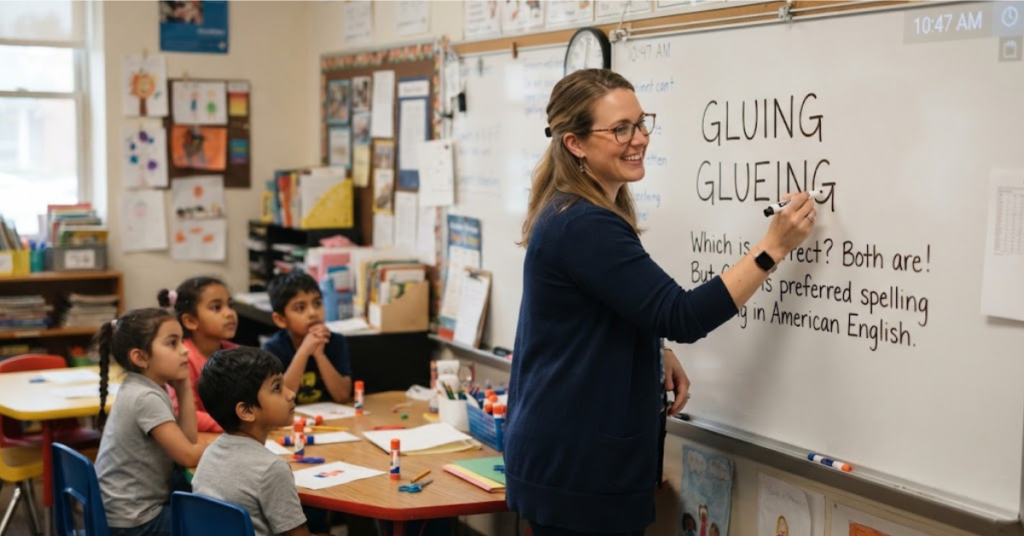
The good news is that there is a clear answer. Gluing is the standard spelling in modern English. Glueing is also found, particularly in some dictionaries and varieties of English, but it is much less common.
If you’re searching for how to spell gluing, this guide explains the spelling rule, why the extra e can cause confusion, and how to use the word correctly.
Gluing or Glueing: The Quick Answer
The preferred spelling is:
Gluing
The less common variant is:
Glueing
So, if you’re wondering glueing or gluing, choose gluing in most modern writing.
Quick comparison
| Spelling | Status | Example |
| Gluing | Standard and widely preferred | She is gluing the pieces together. |
| Glueing | Variant, less common | She is glueing the pieces together. |
For schoolwork, professional writing, websites, and everyday communication, gluing is generally the safest choice.
How Do You Spell Gluing?
If you’re asking how do you spell gluing, the answer is:
G-L-U-I-N-G
The word is formed from the verb glue plus the suffix -ing:
glue + ing → gluing
At first glance, you might expect the final e to remain:
glue + ing → glueing
But English spelling conventions often remove a final silent e before adding a suffix beginning with a vowel.
That gives us:
- make → making
- bake → baking
- write → writing
- use → using
- glue → gluing
There is, however, a small complication with glue, which explains why glueing is sometimes seen.
Why Is It “Gluing” Instead of “Glueing”?
The main reason is the spelling convention involving a final silent e.
When many verbs ending in silent e take -ing, the e is dropped.
For example:
drive → driving
smile → smiling
close → closing
Following the same pattern:
glue → gluing
The result is gluing, with no e between the u and i.
This spelling has become the overwhelmingly common form in contemporary English.
Is Glueing Wrong?
Not necessarily.
Glueing is a real variant spelling that appears in some dictionaries and published sources. It isn’t simply a random misspelling invented by people who don’t know the rule.
However, gluing is much more widely used and is generally considered the preferred spelling.
That distinction matters because English has many words where a less common variant remains technically acceptable even though one spelling is strongly preferred.
For example, if you’re writing:
I am gluing the photographs into the scrapbook.
you are using the standard modern spelling.
Gluing vs Glueing in American and British English
The spelling gluing is widely used in both American and British English.
You may occasionally encounter glueing, but it is far less common.
Unlike some spelling differences between British and American English—such as colour and color—the difference between gluing and glueing isn’t primarily a simple American-versus-British distinction.
In most contexts, gluing is the better choice regardless of which variety of English you’re using.
Gluing Meaning and Definition
Gluing is the present participle of the verb glue.
To glue something means to attach or join it to another surface using glue or an adhesive.
For example:
I’m gluing the broken handle back onto the cup.
The word can also be used figuratively.
For example:
The children were gluing pieces of colored paper onto the poster.
In this case, gluing means attaching the paper with adhesive.
Examples of Gluing in a Sentence
Understanding gluing becomes easier when you see it in everyday sentences.
Everyday examples
- She is gluing the broken pieces back together.
- I’m gluing the label onto the box.
- They spent the afternoon gluing photographs into an album.
- He is gluing cardboard to the wooden frame.
- The children are gluing shapes onto the paper.
- We finished gluing the model together.
More technical examples
- The technician is gluing the components into place.
- The manufacturer uses adhesive for gluing the materials together.
- Proper surface preparation is important when gluing plastic.
- The craftsman carefully measured the pieces before gluing them.
In every example, gluing is spelled without the final e from glue.
How to Remember the Spelling of Gluing
If you frequently forget whether it’s gluing or glueing, use this simple rule:
Drop the final “e” before “-ing”
Think of familiar examples:
- hope → hoping
- bake → baking
- take → taking
- write → writing
- make → making
- glue → gluing
So:
GLUE + ING = GLUING
Not:
GLUE + ING = GLUEING
This isn’t a rule that applies to every English word without exception, but it is a useful way to remember the standard spelling of gluing.
Gluing or Glueing: Common Mistakes
Mistake 1: Keeping the “e” automatically
Because the base word is glue, it’s natural to write:
glueing
But the preferred spelling is:
gluing
Mistake 2: Thinking “gluing” is missing a letter
It may look unusual at first, but gluing is not incomplete.
The spelling is simply:
G-L-U-I-N-G
There is no second e.
Mistake 3: Assuming every “-ing” word follows exactly the same rule
English has exceptions and unusual spellings. That’s why it’s better to learn the conventional spelling of individual words rather than assuming every verb behaves identically.
Gluing vs Glueing: Which Should You Use?
For most situations, use gluing.
Choose gluing when you’re writing:
- School assignments
- Business documents
- Blog posts
- Websites
- Emails
- Instructions
- Social media posts
- Formal or academic writing
Glueing may be encountered as a variant, but using gluing avoids unnecessary confusion and follows the overwhelmingly common modern form.
Is “Gluing” a Verb?
Yes. Gluing comes from the verb glue.
The basic forms are:
- Base form: glue
- Third-person singular: glues
- Present participle: gluing
- Past tense: glued
- Past participle: glued
For example:
I glue the pieces together.
She glues the pieces together.
She is gluing the pieces together.
She glued the pieces together yesterday.
This makes gluing the correct present-participle form for most modern English writing.
Gluing in Different Contexts
The word can appear in several different situations.
Arts and crafts
The students were gluing paper shapes onto cardboard.
Repairs
He spent an hour gluing the broken parts together.
Manufacturing
The machine is responsible for gluing the panels together.
Construction
Workers were gluing the flooring components into place.
Figurative use
English speakers can also use glued metaphorically:
He was glued to the television.
Here, the person isn’t literally attached to the television with adhesive. The expression means they were intensely focused on it.
Frequently Asked Questions
How do you spell gluing?
The standard spelling is gluing:
G-L-U-I-N-G
It is formed from glue and the suffix -ing, with the final e omitted.
Is it gluing or glueing?
Gluing is the standard and much more common spelling. Glueing exists as a less common variant, but gluing is generally preferred.
Is glueing grammatically correct?
Glueing is recognized as a variant spelling, so it isn’t necessarily grammatically incorrect. However, gluing is the more common and preferred form in modern English.
Why is gluing spelled without an e?
The spelling follows the common pattern in which a final silent e is dropped before adding -ing. Thus, glue + ing becomes gluing.
What is the past tense of glue?
The past tense of glue is glued.
She glued the pieces together.
Is “gluing” an English word?
Yes. Gluing is the present participle of glue and means attaching something with glue or adhesive.
Can I use “glueing” in formal writing?
You can encounter glueing as a recognized variant, but gluing is the safer choice for formal writing because it is much more widely accepted and used.
Is gluing spelled differently in British English?
Gluing is also standard in British English. Glueing may appear as a variant, but there is no need to use it simply because you’re writing British English.
Conclusion: Gluing or Glueing?
So, gluing or glueing—which spelling is correct?
The answer is straightforward: gluing is the standard and preferred spelling in modern English.
Although glueing can be found as a variant, it is much less common. If you’re wondering how to spell gluing for an assignment, article, email, or professional document, stick with gluing.
The easiest way to remember it is:
Glue + ing = gluing
Once you remember that the final e is dropped, the spelling becomes much easier. So the next time you’re writing about gluing two pieces together, you can use the shorter spelling with confidence.