- Apposed vs Opposed: Quick Answer
- What Does Apposed Mean?
- What Does Opposed Mean?
- Apposed vs Opposed: The Main Difference
- Apposed or Opposed: Which One Should You Use?
- What Does "Apposing" Mean?
- Apposing vs Opposing
- Apposed in Anatomy and Medicine
- Opposed in Everyday English
- Apposed vs Opposed in Sentences
- Common Mistakes With Apposed and Opposed
- How to Remember Apposed vs Opposed
- Is "Apposed" a Common Word?
- Is "Apposed to" Correct?
- Frequently Asked Questions
- Conclusion: Apposed vs Opposed
Two words can look almost identical and still mean completely different things. Apposed vs opposed is a perfect example. Although apposed and opposed differ by only a couple of letters, they are not interchangeable.
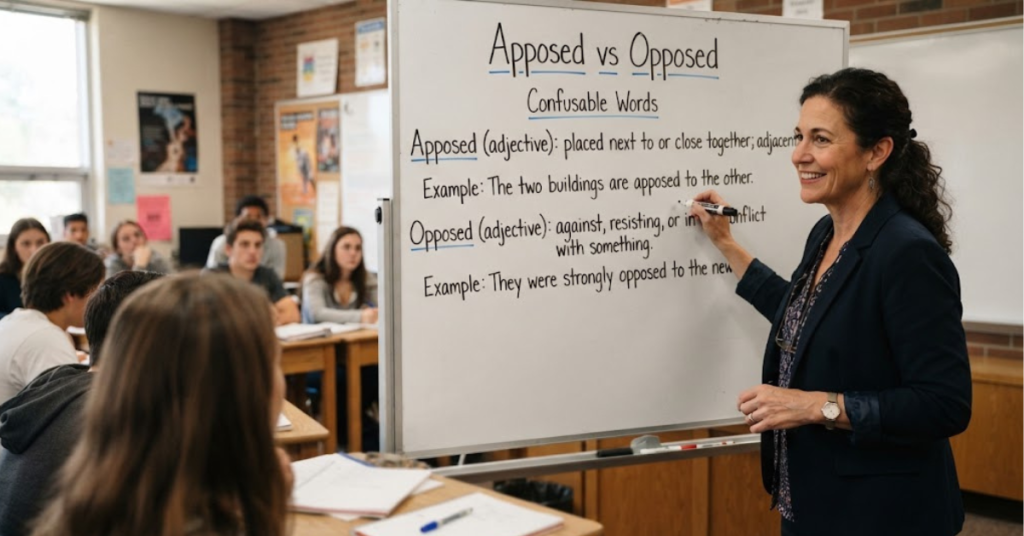
Apposed usually means placed next to or brought into close contact with something else, while opposed means being against something or in disagreement with it. Once you understand this basic distinction, choosing the right word becomes much easier.
Apposed vs Opposed: Quick Answer
The simplest way to remember the difference is:
- Apposed = placed next to, against, or in close contact with something.
- Opposed = against something in opinion, position, action, or competition.
For example:
The two surfaces were apposed to each other.
This means the surfaces were positioned closely together.
The committee was opposed to the proposed changes.
This means the committee disagreed with or resisted the changes.
So, if you’re wondering opposed or apposed, the correct choice depends entirely on what you mean.
What Does Apposed Mean?
Apposed is the past tense and past participle of appose. The verb appose means to place something next to or in close contact with something else.
It is relatively uncommon in everyday English and appears more often in technical, scientific, anatomical, or academic writing.
For example:
The edges of the two materials were apposed during the procedure.
Here, apposed means the edges were brought together or positioned in close contact.
Another example is:
The two surfaces were carefully apposed.
In this sentence, the surfaces were placed against or alongside each other.
Apposed Meaning in Simple Terms
You can think of apposed as meaning:
- placed beside
- positioned next to
- brought into contact
- placed against
- closely aligned
It does not mean “against” in the sense of disagreement.
What Does Opposed Mean?
Opposed is the past tense and past participle of oppose. It means to resist, disagree with, challenge, or be against something.
This is a much more common word than apposed.
For example:
Many residents were opposed to the new construction plan.
The residents disagreed with or resisted the plan.
You can also use opposed when describing two competing sides:
The two teams were opposed to each other in the final match.
In this context, the teams were facing each other as competitors.
Opposed Meaning in Simple Terms
Opposed can mean:
- against something
- disagreeing with something
- resisting something
- competing against someone
- in conflict with something
For example:
She is strongly opposed to the proposal.
This means she strongly disagrees with the proposal.
Apposed vs Opposed: The Main Difference
The key difference is the relationship being described.
| Word | Meaning | Typical Use |
| Apposed | Placed next to or in close contact | Technical, scientific, anatomical |
| Opposed | Against, resisting, or disagreeing | Everyday, political, social, competitive |
A useful memory trick is:
Apposed = adjacent or aligned.
Opposed = against or disagreeing.
Consider these two sentences:
The bones were apposed.
The bones were positioned closely together.
The doctors were opposed to the proposal.
The doctors disagreed with the proposal.
Changing one word for the other would completely change the meaning.
Apposed or Opposed: Which One Should You Use?
When deciding between apposed or opposed, look at the context.
Ask yourself:
Does the sentence describe physical position or placement?
If yes, apposed may be the correct word.
The surfaces were apposed.
Does the sentence describe disagreement, resistance, or competition?
If yes, use opposed.
The employees were opposed to the new policy.
This simple question can prevent most mistakes.
What Does “Apposing” Mean?
Apposing is the present participle of appose. It means placing something next to or in close contact with something else.
For example:
The surgeon was apposing the edges of the wound.
Here, apposing describes the action of bringing the edges together.
Because appose is relatively uncommon, apposing is also uncommon in general conversation.
You are much more likely to encounter it in specialized writing, particularly in medicine, anatomy, biology, and other technical fields.
Apposing vs Opposing
The difference between apposing vs opposing follows the same pattern.
Apposing
Apposing means placing something beside or against something else.
The technician was apposing the two surfaces.
Opposing
Opposing means resisting, disagreeing with, or competing against something.
The senator was opposing the proposed legislation.
These words may sound similar when spoken, but their meanings are completely different.
A Simple Comparison
| Apposing | Opposing |
| Placing together | Being against |
| Physical or positional | Conceptual, social, competitive, or physical |
| From appose | From oppose |
| Less common | Very common |
Apposed in Anatomy and Medicine
One area where apposed can be particularly useful is anatomy.
In medical and anatomical writing, structures may be described as apposed when they are positioned closely together or brought into contact.
For example:
The tissue surfaces were apposed.
The sentence describes the physical relationship between the surfaces rather than disagreement.
This distinction is important because technical language often needs to describe precise physical relationships. In such contexts, apposed provides a specific meaning that opposed does not.
Apposed Surfaces
When two surfaces are described as apposed, they are generally positioned against or close to one another.
This does not necessarily imply that they are fighting, resisting, or disagreeing. It is simply a description of their physical arrangement.
Opposed in Everyday English
Unlike apposed, opposed is a normal part of everyday English.
You might hear it in conversations about:
- politics
- business
- personal opinions
- social issues
- sports
- disagreements
- proposals
- competition
Examples include:
The residents were opposed to the development.
She opposed the decision.
The two candidates had opposing views.
The teams were opposed in the championship.
In each example, opposed communicates some form of conflict, resistance, disagreement, or competition.
Apposed vs Opposed in Sentences
Seeing the words in context makes the difference clearer.
Examples with “Apposed”
- The two surfaces were apposed.
- The tissue edges were carefully apposed.
- The structures were apposed during the examination.
- The edges were brought together and apposed.
In these sentences, apposed describes physical positioning or contact.
Examples with “Opposed”
- She was opposed to the proposed changes.
- Many workers were opposed to the new policy.
- The two groups were strongly opposed.
- He opposed the decision during the meeting.
Here, opposed describes disagreement, resistance, or conflict.
Common Mistakes With Apposed and Opposed
Mistake 1: Using “apposed” to mean “against”
This is probably the most common misunderstanding.
If you mean that someone disagrees with an idea, use opposed.
Incorrect:
I am apposed to the proposal.
Correct:
I am opposed to the proposal.
Mistake 2: Writing “apposing” instead of “opposing”
If you’re talking about resisting something, the correct form is opposing.
They are opposing the plan.
Not:
They are apposing the plan.
Mistake 3: Assuming the words are interchangeable
They aren’t.
Although their spellings and pronunciations can be confusing, appose and oppose are different verbs with different meanings.
Mistake 4: Using “apposed” in ordinary situations
Apposed is a legitimate word, but it is relatively specialized.
In everyday writing, you may find simpler alternatives such as:
- placed next to
- positioned against
- brought together
- placed alongside
Using a more familiar phrase can sometimes make your writing easier to understand.
How to Remember Apposed vs Opposed
Here’s an easy memory aid:
APPosed → APPosition
Think of apposed as relating to position.
Something is apposed when it is placed next to or against something else.
OPposed → OPposition
Think of opposed as relating to opposition.
Something is opposed when it is resisted, rejected, or disagreed with.
So:
Apposed = position
Opposed = opposition
This isn’t a formal linguistic rule, but it’s a useful way to remember the distinction.
Is “Apposed” a Common Word?
No. Apposed is a real English word, but it is considerably less common than opposed.
It tends to appear in specialized contexts where describing close physical positioning is important.
By contrast, opposed is widely used in everyday English.
If you’re writing a general-audience article, email, or conversation, you’ll probably encounter opposed far more often.
Is “Apposed to” Correct?
It can be correct in a literal or technical sense when apposed describes something being placed against or next to something else.
However, if you’re trying to say that someone disagrees with something, the phrase you want is:
opposed to
For example:
She is opposed to the plan.
This means she disagrees with or resists the plan.
Using apposed to in this context would be incorrect.
Frequently Asked Questions
What is the difference between apposed and opposed?
Apposed means placed next to, against, or in close contact with something. Opposed means against, resistant to, or in disagreement with something.
Is apposed a real word?
Yes. Apposed is the past tense and past participle of appose. It is a legitimate word, although it is much less common than opposed and is often used in technical contexts.
What does apposed mean?
Apposed means positioned next to or brought into close contact with something. It is commonly found in technical or scientific writing.
What does opposed mean?
Opposed means being against something, disagreeing with it, resisting it, or competing against it.
Should I say “opposed or apposed”?
If you mean against or in disagreement with, use opposed. If you mean placed next to or in close contact with, use apposed.
What is the difference between apposing and opposing?
Apposing means placing things next to or against each other. Opposing means resisting, disagreeing with, or competing against something.
Is “I am apposed to it” correct?
Not if you mean “I disagree with it.” The correct expression is “I am opposed to it.”
Is “apposed to” the same as “opposed to”?
No. Opposed to commonly means against or in disagreement with. Apposed to relates to being physically positioned next to or against something and is much less common.
What is an example of apposed?
“The two tissue surfaces were apposed.”
This means the tissue surfaces were positioned closely together.
What is an example of opposed?
“The committee was opposed to the proposal.”
This means the committee disagreed with or resisted the proposal.
Conclusion: Apposed vs Opposed
The difference between apposed vs opposed comes down to a simple idea: position versus opposition.
Apposed describes things that are placed next to or in close contact with each other, making it especially useful in technical and scientific contexts. Opposed, on the other hand, describes disagreement, resistance, conflict, or competition and is much more common in everyday English.
So, when choosing between apposed or opposed, ask what you are trying to say. If something is being positioned alongside something else, apposed may be right. If someone is against an idea, decision, or person, the correct word is opposed.
Likewise, remember that apposing means bringing things together, while opposing means resisting or standing against something. Once you connect apposed with position and opposed with opposition, the distinction becomes much easier to remember.