- Bear vs Bare: The Quick Answer
- Bear vs Bare Meaning
- What Does "Bare" Mean?
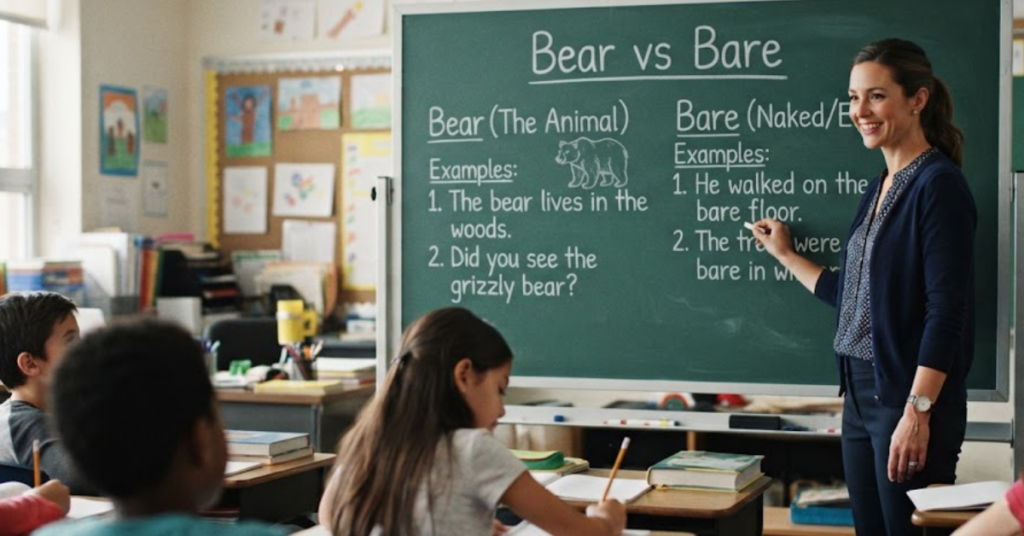
- Bear vs Bare Definition: Side-by-Side Comparison
- Bear With Me or Bare With Me?
- Common Uses of Bear
- Common Uses of Bare
- Easy Trick to Remember the Difference
- Common Mistakes to Avoid
- Example Sentences
- Frequently Asked Questions
- Conclusion
English is full of words that sound exactly alike but have completely different meanings. One of the most commonly confused pairs is Bear vs Bare. Because they are pronounced the same, many writers accidentally use one when they mean the other.
If you’ve ever wondered about bear vs bare meaning, struggled with the phrase bear vs bare with me, or wanted a simple explanation of the bear vs bare definition, this guide will clear up the confusion. By the end, you’ll know exactly when to use each word and how to avoid one of English’s most common mistakes.
Bear vs Bare: The Quick Answer
Although they sound identical, these words have different meanings.
- Bear usually refers to carrying, enduring, supporting, producing, or the large furry animal.
- Bare means uncovered, exposed, empty, or without something.
Correct Examples
- Please bear with me while I finish this report.
- The tree will bear fruit next summer.
- He walked across the bare floor.
- She stood with bare feet on the sand.
Incorrect Examples
- Please bare with me while I finish.
- The tree will bare fruit next summer.
The phrase is always bear with me, not bare with me.
Bear vs Bare Meaning
Understanding the meanings separately makes them much easier to remember.
What Does “Bear” Mean?
The word bear has several meanings depending on how it is used.
As a verb, it can mean:
- To carry something
- To endure or tolerate
- To support weight
- To produce or give birth
- To accept responsibility
As a noun, it refers to the large mammal found in many parts of the world.
Examples
- I can’t bear the noise.
- The bridge can bear heavy traffic.
- Apple trees bear fruit every year.
- Polar bears live in Arctic regions.
What Does “Bare” Mean?
The word bare generally means uncovered, exposed, plain, or lacking something.
It can describe:
- Skin without clothing
- Empty spaces
- Minimal decoration
- Removing a covering
Examples
- She walked across the bare floor.
- The trees were bare during winter.
- He revealed the bare facts.
- Please bare your shoulders for the examination.
Unlike bear, bare has nothing to do with carrying or enduring.
Bear vs Bare Definition: Side-by-Side Comparison
| Bear | Bare |
| Carry or endure | Uncovered or exposed |
| Support weight | Without covering |
| Produce or give birth | Plain or empty |
| Large animal | Reveal or uncover |
The easiest way to distinguish them is to think about the context. If you’re talking about carrying, enduring, or supporting, choose bear. If you’re describing something uncovered, choose bare.
Bear With Me or Bare With Me?
This is one of the most frequently searched grammar questions.
The correct expression is:
Bear with me
The phrase means:
- Be patient.
- Wait for me.
- Please tolerate this delay.
Correct
- Please bear with me while I restart my computer.
- Bear with me for just a moment.
- Thank you for bearing with us.
Incorrect
- Please bare with me.
- Bare with us while we investigate.
Why? Because bear means “to endure” or “to be patient,” while bare means “to uncover.”
Common Uses of Bear
You’ll encounter bear in many everyday expressions.
Carrying or Supporting
- Bear the weight
- Bear responsibility
- Bear the cost
Enduring Something
- Bear the pain
- Bear the disappointment
- Bear criticism
Producing
- Trees bear fruit.
- Plants bear seeds.
Animal
- Brown bear
- Black bear
- Polar bear
Common Uses of Bare
The word bare often describes something exposed or minimal.
Physical Appearance
- Bare feet
- Bare hands
- Bare shoulders
Objects
- Bare walls
- Bare branches
- Bare floor
As a Verb
- Bare your soul.
- Bare your teeth.
- Bare the facts.
In these cases, bare means to reveal or expose.
Easy Trick to Remember the Difference
A simple memory tip can help you choose the correct word every time.
Remember “Bear” = Carry
Think of a bear carrying a heavy backpack.
If the sentence involves:
- Carrying
- Enduring
- Supporting
- Being patient
Use bear.
Remember “Bare” = Naked
Think of bare as meaning uncovered.
If something is:
- Exposed
- Empty
- Without covering
Use bare.
Common Mistakes to Avoid
Here are some errors that appear frequently.
Incorrect
- Bare with me.
- I can’t bare this pain.
- The tree bares fruit every year.
Correct
- Bear with me.
- I can’t bear this pain.
- The tree bears fruit every year.
Similarly:
Incorrect
- Bear feet
Correct
- Bare feet
The words sound the same, but they cannot be used interchangeably.
Example Sentences
Here are more examples to reinforce the difference.
Using “Bear”
- We must bear the consequences of our decisions.
- She couldn’t bear to watch the movie.
- The bridge bears thousands of vehicles every day.
- The company will bear the costs.
Using “Bare”
- The mountain looked bare after the wildfire.
- His apartment had bare walls.
- She preferred walking barefoot on the bare sand.
- The evidence laid bare the truth.
Frequently Asked Questions
Bear vs Bare: Which is correct?
Both words are correct, but they have different meanings. Bear relates to carrying, enduring, or supporting, while bare means uncovered or exposed.
Bear vs bare with me: Which phrase is right?
The correct expression is bear with me because bear means to be patient or endure.
What is the difference between bear and bare?
Bear is commonly used for carrying, tolerating, supporting, producing, or referring to the animal. Bare means uncovered, exposed, or without something.
Can “bare” mean reveal?
Yes. As a verb, bare means to uncover or reveal.
Example:
- He bared his feelings.
Why do people confuse bear and bare?
They are homophones, meaning they sound exactly alike but have different spellings and meanings.
How can I remember which one to use?
Remember:
- Bear = carry or endure.
- Bare = uncovered or exposed.
Conclusion
Understanding Bear vs Bare is easier once you focus on the meaning instead of the pronunciation. Although both words sound identical, they serve very different purposes. Bear refers to carrying, enduring, supporting, producing, or the well-known animal, while bare describes something uncovered, exposed, or revealed.
If you remember just one rule, let it be this: the phrase is always bear with me, never bare with me. Keeping these definitions in mind will help you write with greater confidence, avoid common mistakes, and communicate more clearly in both everyday conversations and professional writing.