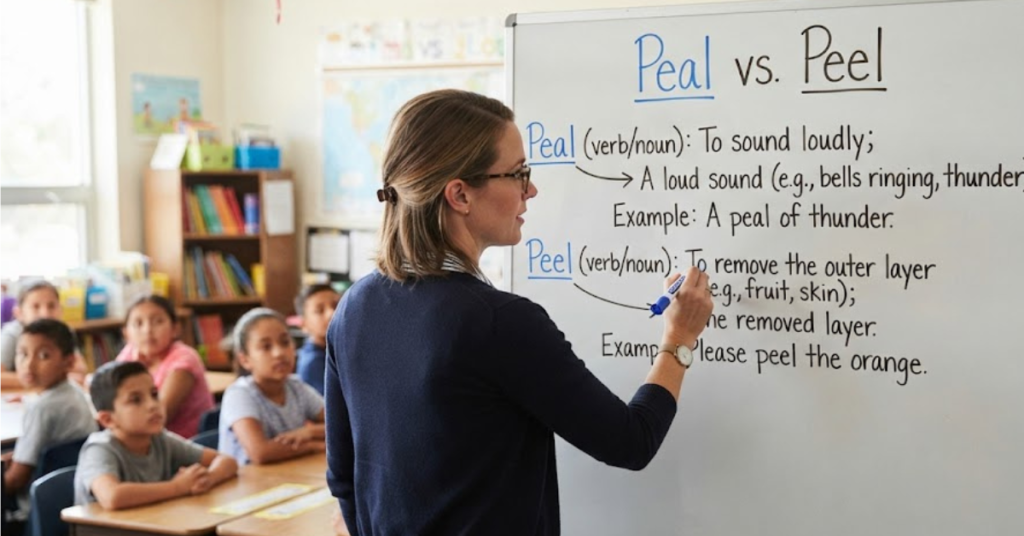
- What Does "Peel" Mean?
- What Does "Peal" Mean?
- Peal vs Peel: The Main Difference
- Peel or Peal: Which One Is Correct?
- Pealing or Peeling: What's the Difference?
- Peeling vs Pealing: Side-by-Side Comparison
- Why Are These Words Confusing?
- Common Expressions Using "Peel"
- Common Expressions Using "Peal"
- Easy Memory Tricks
- Common Mistakes to Avoid
- Which Word Is More Common?
- Quick Comparison: Peal vs Peel
- FAQs
- Conclusion
English is full of words that sound exactly alike but have completely different meanings. One pair that often causes confusion is peal vs peel. Since both words are pronounced the same way, it’s easy to mix them up in writing. Whether you’re wondering about peel or peal, pealing or peeling, or peeling vs pealing, understanding the difference is simpler than you might think.
The short answer is this: “peel” usually relates to removing an outer layer, while “peal” refers to a loud ringing sound, especially from bells or thunder. Although they sound identical, they’re never interchangeable because they describe entirely different actions.
In this guide, we’ll explain the meanings of both words, provide examples, compare their uses, and share easy memory tricks to help you choose the correct spelling every time.
What Does “Peel” Mean?
Peel is both a verb and a noun. It generally refers to removing the outer layer or skin from something.
As a verb, it means to strip away an outer covering.
Examples include:
- Peel an orange
- Peel potatoes
- Peel paint from a wall
- Peel wallpaper
As a noun, peel refers to the outer skin itself.
Examples:
- Banana peel
- Lemon peel
- Orange peel
Examples of “Peel” in Sentences
Here are some common examples:
- Please peel the apples before baking the pie.
- The paint began to peel after years of exposure to the weather.
- She slipped on a banana peel.
- Sunburned skin may peel after several days.
In every case, the word involves an outer layer being removed or coming off.
What Does “Peal” Mean?
Peal is much less common than peel. It usually refers to a loud ringing sound, especially from church bells.
As a noun, a peal is a burst or series of loud sounds.
As a verb, to peal means to ring loudly.
Examples of “Peal” in Sentences
- The church bells rang in a joyful peal.
- A peal of thunder echoed across the valley.
- Bells pealed throughout the town during the celebration.
- The audience erupted in peals of laughter.
Although bells are the most common association, the word can also describe thunder or loud laughter.
Peal vs Peel: The Main Difference
The easiest way to distinguish peal vs peel is to remember what each word refers to.
| Word | Meaning | Common Context |
| Peel | Remove an outer layer | Fruit, vegetables, paint, skin |
| Peal | Loud ringing sound | Bells, thunder, laughter |
One deals with layers, while the other deals with sounds.
Peel or Peal: Which One Is Correct?
Both words are correct—but only in the appropriate context.
Use peel when talking about:
- Fruit
- Vegetables
- Skin
- Paint
- Wallpaper
- Bark
- Protective layers
Use peal when referring to:
- Church bells
- Thunder
- Loud laughter
- Ringing sounds
Pealing or Peeling: What’s the Difference?
One of the most common spelling questions is pealing or peeling.
The answer depends entirely on what you’re describing.
Peeling
Peeling means removing an outer covering or having an outer layer come off.
Examples:
- Peeling potatoes
- Peeling paint
- Peeling wallpaper
- Peeling skin after sunburn
Example sentence:
She spent the afternoon peeling carrots for dinner.
Pealing
Pealing refers to producing or making loud ringing sounds.
Examples:
- Bells pealing across the village
- Thunder pealing overhead
- Church bells pealing on Christmas morning
Example sentence:
The cathedral bells were pealing for the wedding.
Peeling vs Pealing: Side-by-Side Comparison
| Peeling | Pealing |
| Removing a layer | Ringing loudly |
| Skin peeling | Bells pealing |
| Peeling fruit | Pealing thunder |
| Peeling potatoes | Pealing church bells |
| Very common | Less common |
Why Are These Words Confusing?
The confusion happens because peal and peel are homophones.
Homophones are words that:
- Sound exactly alike
- Have different spellings
- Have different meanings
Other examples include:
- Flour vs flower
- Brake vs break
- Sole vs soul
- Principal vs principle
- Peace vs piece
Since pronunciation doesn’t help, context becomes essential.
Common Expressions Using “Peel”
You’ll encounter peel in many everyday phrases.
Examples include:
- Peel back the layers
- Peel an orange
- Peel potatoes
- Peel away the tape
- Peel off a sticker
- Peel paint
- Peel garlic
These expressions all involve removing or separating an outer layer.
Common Expressions Using “Peal”
Although less frequent, peal appears in several established expressions.
Examples include:
- A peal of thunder
- Peals of laughter
- Church bells pealing
- A merry peal of bells
These all describe loud, resonant sounds.
Easy Memory Tricks
Remembering the difference doesn’t have to be difficult.
Trick #1: Peel Has Two “E”s Like “Eat”
You usually peel food before you eat it.
Both words contain double “e.”
Trick #2: Peal Contains “A” Like “Alarm”
An alarm makes a loud sound.
So does a peal.
Trick #3: Peel = Layer
Whenever something’s outer layer is removed, think peel.
Trick #4: Peal = Ringing
Whenever you hear bells or thunder, think peal.
Common Mistakes to Avoid
Here are mistakes that many English learners make.
Incorrect
Peel of thunder
Peal of thunder
Incorrect
Pealing potatoes
Peeling potatoes
Incorrect
The bells were peeling.
The bells were pealing.
Incorrect
The orange peal tastes bitter.
The orange peel tastes bitter.
Which Word Is More Common?
In modern English, peel is used far more often than peal.
You’ll frequently encounter peel in:
- Cooking recipes
- Gardening guides
- Medical advice
- Beauty articles
- DIY projects
Meanwhile, peal mainly appears in:
- Literature
- News stories
- Religious contexts
- Historical writing
- Creative storytelling
Quick Comparison: Peal vs Peel
| Feature | Peel | Peal |
| Pronunciation | Same | Same |
| Meaning | Remove outer layer | Loud ringing sound |
| Part of Speech | Noun & Verb | Noun & Verb |
| Everyday Use | Very common | Less common |
| Food Context | ✔ | ✖ |
| Bells & Thunder | ✖ | ✔ |
FAQs
What is the difference between peal vs peel?
Peel refers to removing an outer layer or the outer skin itself, while peal refers to a loud ringing sound, such as church bells or thunder.
Is it pealing or peeling potatoes?
The correct phrase is peeling potatoes because you’re removing the outer skin.
Is it pealing bells or peeling bells?
The correct phrase is bells pealing because bells produce ringing sounds.
What does a peal of laughter mean?
A peal of laughter means a loud burst of laughter, often shared by a group of people.
Is orange peel or orange peal correct?
Orange peel is correct because it refers to the fruit’s outer skin.
Why do peal and peel sound the same?
They’re homophones—words with identical pronunciation but different spellings and meanings.
Conclusion
Understanding peal vs peel comes down to remembering one simple distinction: peel is about removing an outer layer, while peal is about loud, ringing sounds. Whether you’re deciding between peel or peal, choosing pealing or peeling, or comparing peeling vs pealing, the context of your sentence will always point you to the correct word.
By using the memory tricks and examples in this guide, you’ll be able to avoid one of English’s most common homophone mistakes. The next time you’re writing about fruit, paint, bells, or thunder, you’ll know exactly which spelling to choose. If you enjoy learning about commonly confused words, explore our other grammar guides to continue improving your English vocabulary and writing skills.