- Cacoon or Cocoon: Which Is Correct?
- What Does Cocoon Mean?
- Why Do People Misspell Cocoon?
- Cocoon Meaning in Different Contexts
- Common Examples of Cocoon
- Cocoon vs. Chrysalis
- Memory Trick for Cocoon Spelling
- Common Mistakes to Avoid
- Why Correct Spelling Matters
- Frequently Asked Questions (FAQs)
- Conclusion
Have you ever typed cacoon and wondered if it was correct? You’re not alone. Words with repeated vowels often cause confusion, and cocoon is one of the most frequently misspelled. Many people accidentally write cacoon, caccoon, or other variations because the pronunciation doesn’t make the spelling immediately obvious.
The correct spelling is cocoon. Spellings like cacoon and caccoon are common mistakes and are not recognized in standard English dictionaries. In this guide, we’ll explain the correct cocoon spelling, define the word, provide practical examples, and share easy memory tricks to help you remember it every time.
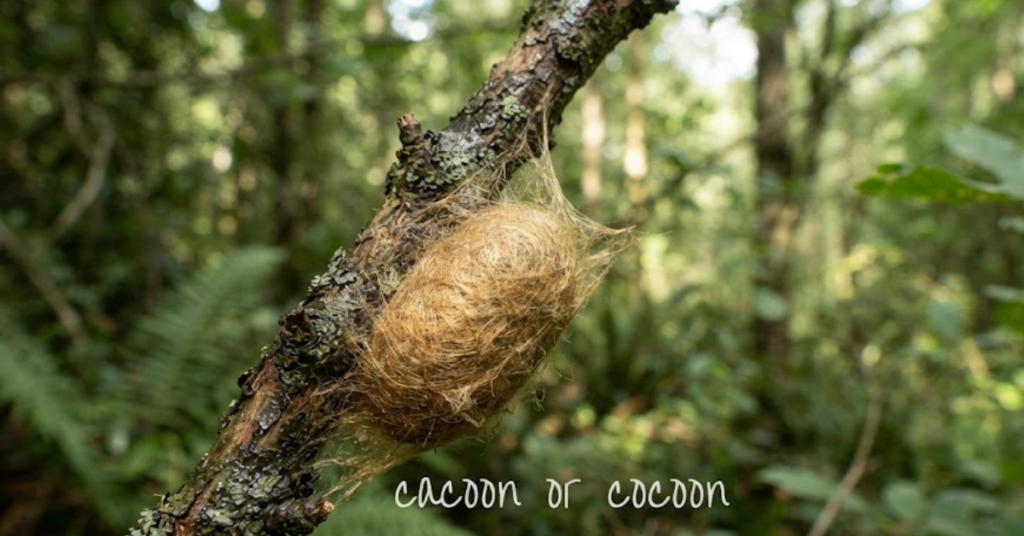
Cacoon or Cocoon: Which Is Correct?
The correct spelling is:
Cocoon
Incorrect spellings include:
- Cacoon
- Caccoon
- Cocon
- Coccoon
Whether you’re referring to an insect’s protective covering or using the word figuratively, cocoon is always the correct spelling.
Examples:
- The caterpillar built a cocoon before becoming a butterfly.
- She wrapped herself in a warm blanket like a cocoon.
- The sleeping bag created a cozy cocoon of warmth.
What Does Cocoon Mean?
A cocoon is a protective casing spun by the larvae of many insects, especially moths, during the pupal stage of their life cycle. Inside the cocoon, the insect undergoes a remarkable transformation before emerging as an adult.
Beyond biology, cocoon is also used figuratively to describe a place or feeling of safety, comfort, or isolation.
Examples:
- The caterpillar remained inside its cocoon for several weeks.
- After a stressful week, she stayed home in her cozy cocoon.
- The hotel room felt like a peaceful cocoon away from the busy city.
Why Do People Misspell Cocoon?
There are several reasons why cocoon spelling can be tricky.
1. Unusual Letter Pattern
The word contains two pairs of repeated vowels:
- co
- coon
Many writers accidentally replace the first o with an a, resulting in cacoon.
2. Pronunciation
In everyday speech, the first syllable is often pronounced quickly, making it harder to identify the correct spelling.
3. Double-Letter Confusion
English contains many words with double letters, leading people to invent spellings like caccoon, even though they are incorrect.
Cocoon Meaning in Different Contexts
Biology
A cocoon is the silk casing that protects an insect during metamorphosis.
Example:
- The moth emerged from its cocoon.
Personal Comfort
People often use cocoon to describe wrapping themselves in blankets or staying in a safe, comfortable environment.
Example:
- She spent the rainy afternoon in a cozy cocoon of blankets.
Architecture and Design
The word may also describe spaces designed to feel private or sheltered.
Example:
- The reading nook created a quiet cocoon for relaxation.
Emotional Well-Being
Figuratively, cocoon can refer to protecting oneself from stress or outside distractions.
Example:
- He created a cocoon of calm by turning off his phone for the weekend.
Common Examples of Cocoon
Nature
- A butterfly does not emerge from a cocoon—it emerges from a chrysalis. Many moths, however, spin cocoons.
- The silkworm spins a cocoon made of silk fibers.
Home
- The weighted blanket felt like a comforting cocoon.
- The sleeping bag formed a warm cocoon on the cold night.
Everyday Conversation
- I just want to stay in my little cocoon today.
- The cabin became our peaceful cocoon during the storm.
Cocoon vs. Chrysalis
Many people use these words interchangeably, but they are not exactly the same.
| Term | Meaning |
| Cocoon | A silk covering spun by many moth larvae and other insects |
| Chrysalis | The hard pupal stage of a butterfly, usually without a silk cocoon |
In simple terms:
- Most moths spin cocoons.
- Most butterflies form chrysalises.
Understanding this distinction is especially useful in biology and nature writing.
Memory Trick for Cocoon Spelling
Here’s an easy way to remember the correct spelling:
A cocoon has two “o”s at the beginning and two “o”s at the end—just like it wraps something completely.
Think of the word as:
co + coon
Not:
- Cacoon
- Caccoon
The repeated o pattern is the key to remembering the correct spelling.
Common Mistakes to Avoid
Avoid these incorrect spellings:
- Cacoon
- Caccoon
- Coccoon
- Cocon
Correct spelling:
- Cocoon
If you’re unsure, remember that dictionaries only recognize cocoon.
Why Correct Spelling Matters
Using the correct cocoon spelling improves:
- Academic writing
- Nature and science articles
- Creative writing
- Professional communication
- Search engine optimization
- Overall credibility
Accurate spelling also helps readers understand your message without distraction.
Frequently Asked Questions (FAQs)
Is it cacoon or cocoon?
The correct spelling is cocoon. Cacoon is a common misspelling.
Is caccoon a real word?
No. Caccoon is not recognized in standard English dictionaries.
What does cocoon mean?
A cocoon is a protective silk covering spun by many insect larvae during metamorphosis. It can also describe a place of comfort or protection.
How do you spell cocoon?
The correct spelling is:
Cocoon
Why is cocoon difficult to spell?
Many people confuse the repeated vowels and accidentally write cacoon or caccoon because of pronunciation.
Is cocoon only used in biology?
No. While its original meaning is biological, cocoon is also widely used figuratively to describe comfort, safety, privacy, or emotional protection.
Is cocoon a noun or a verb?
It can be both.
As a noun:
- The moth spun a cocoon.
As a verb:
- She cocooned herself in blankets during the winter storm.
Conclusion
When deciding between cacoon or cocoon, the correct spelling is always cocoon. Misspellings such as cacoon and caccoon are common because of the word’s unusual vowel pattern, but they are not accepted in standard English. Whether you’re writing about insect metamorphosis, describing a cozy retreat, or using the word metaphorically, cocoon is the only correct choice.
A simple way to remember the correct cocoon spelling is to focus on its repeated o pattern—co + coon. By using the correct spelling consistently, you’ll improve the clarity, professionalism, and accuracy of your writing in both everyday communication and more formal contexts.
If you found this guide helpful, explore our other grammar and spelling articles to learn more about commonly confused English words and strengthen your writing skills.