- Qualify vs Quantify: The Main Difference
- What Does Qualify Mean?
- What Does Quantify Mean?
- Qualify vs Quantify: Side-by-Side Comparison
- Quantified vs Qualified
- Quantification vs Qualification
- Common Uses of Qualify
- Common Uses of Quantify
- Memory Trick to Remember the Difference
- Common Mistakes to Avoid
- Frequently Asked Questions (FAQs)
- Conclusion
If you’ve ever wondered about qualify vs quantify, you’re not alone. These two verbs look and sound similar, but they have very different meanings. Because both are common in academic writing, business, science, and everyday communication, it’s easy to mix them up—especially if you’re writing quickly.
The key difference is simple: qualify means to meet requirements, describe, or limit something, while quantify means to measure or express something as a quantity or number. Understanding qualify vs quantify will help you choose the right word and make your writing more precise and professional.
Qualify vs Quantify: The Main Difference
Although the words share a similar ending, they serve different purposes.
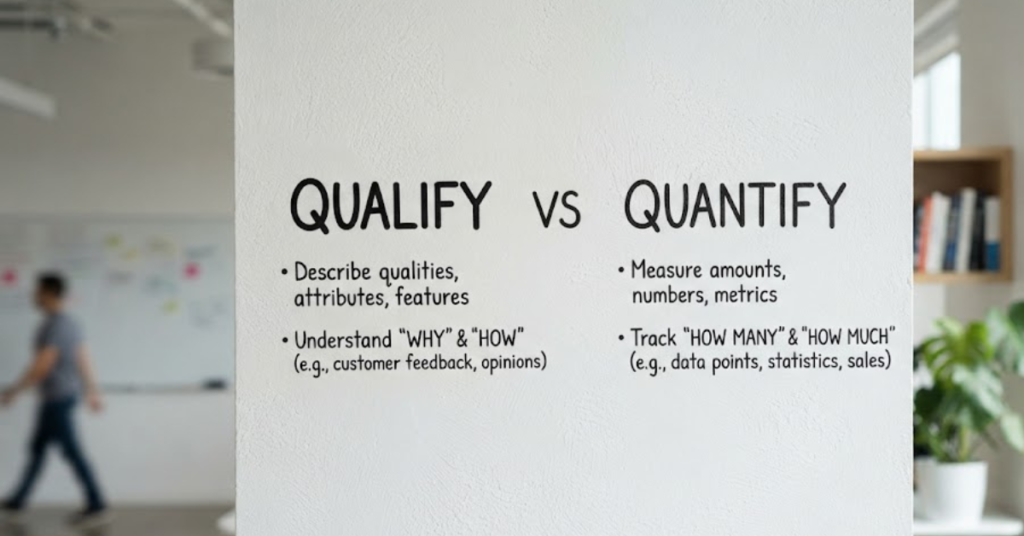
- Qualify = To become eligible, describe, modify, or limit.
- Quantify = To measure, count, or express numerically.
Examples:
- She qualified for the championship after winning the regional event.
- Scientists quantified the amount of carbon emissions produced each year.
One deals with requirements or descriptions, while the other deals with numbers and measurement.
What Does Qualify Mean?
The verb qualify has several meanings depending on the context.
1. To Meet Requirements
This is the most common meaning.
Examples:
- You must qualify for the scholarship.
- She qualified for the Olympic trials.
- He qualified for the final interview.
2. To Modify or Limit a Statement
In writing and speaking, qualify means adding information that limits or clarifies a statement.
Examples:
- The professor qualified his earlier comments.
- I should qualify that statement by mentioning recent research.
3. To Make Someone Eligible
Examples:
- Additional training qualified her for a promotion.
- The certification qualifies candidates for specialized positions.
What Does Quantify Mean?
The verb quantify means to express something in measurable or numerical terms.
It is commonly used in:
- Science
- Business
- Economics
- Statistics
- Research
- Data analysis
Examples:
- Researchers quantified the results of the experiment.
- It’s difficult to quantify customer satisfaction.
- The company quantified its annual energy savings.
Whenever you’re assigning numbers, measurements, or values, quantify is the correct choice.
Qualify vs Quantify: Side-by-Side Comparison
| Word | Meaning | Example |
| Qualify | Meet requirements, describe, or limit | She qualified for the marathon. |
| Quantify | Measure or express numerically | Scientists quantified the data. |
A quick rule:
- Requirements or conditions? → Qualify
- Numbers or measurements? → Quantify
Quantified vs Qualified
Many writers also confuse quantified vs qualified.
Qualified
Means:
- Met the necessary requirements.
- Became eligible.
- Was modified or clarified.
Examples:
- She is fully qualified for the position.
- His remarks were carefully qualified.
Quantified
Means:
- Measured.
- Calculated.
- Expressed numerically.
Examples:
- The researchers quantified the risk.
- Sales growth was quantified using quarterly reports.
One describes eligibility or description, while the other describes measurement.
Quantification vs Qualification
The same distinction applies to the related nouns.
Qualification
Refers to:
- Eligibility
- Credentials
- Skills
- Restrictions or conditions
Examples:
- A university degree is an important qualification.
- Experience is one of the job qualifications.
Quantification
Refers to:
- Measurement
- Numerical analysis
- Statistical evaluation
- Assigning values
Examples:
- Quantification improved the accuracy of the research.
- Environmental quantification supports policy decisions.
Common Uses of Qualify
You’ll encounter qualify in many situations.
Education
- Students must qualify for financial aid.
- She qualified for the honor roll.
Sports
- The team qualified for the finals.
- Only the fastest runners qualified.
Employment
- Applicants must qualify through an assessment.
- He qualified for a management role.
Writing
- The author qualified the conclusion with additional evidence.
Common Uses of Quantify
Quantify is especially common in technical and analytical fields.
Science
- Researchers quantified protein levels.
- Scientists quantified air pollution.
Business
- The company quantified customer engagement.
- Analysts quantified market demand.
Healthcare
- Doctors quantified improvements after treatment.
- Researchers quantified the effectiveness of the medication.
Finance
- Investors quantified financial risk.
- The report quantified annual revenue growth.
Memory Trick to Remember the Difference
Here’s an easy way to keep them straight:
Qualify = Quality or Qualifications
Think of:
- Qualifications
- Eligibility
- Conditions
Quantify = Quantity
Notice that quantify begins with quant-, just like quantity.
If you’re working with numbers, measurements, or statistics, you’re almost certainly talking about quantify.
Common Mistakes to Avoid
Avoid these common errors.
Incorrect:
- Scientists qualified the amount of rainfall.
- We need to qualify customer satisfaction with numbers.
Correct:
- Scientists quantified the amount of rainfall.
- We need to quantify customer satisfaction.
Likewise:
Incorrect:
- She quantified for the tournament.
Correct:
- She qualified for the tournament.
Frequently Asked Questions (FAQs)
What is the difference between qualify vs quantify?
Qualify means to meet requirements, become eligible, or limit a statement. Quantify means to measure or express something numerically.
When should I use qualify?
Use qualify when talking about eligibility, credentials, requirements, or modifying a statement.
Example:
- She qualified for the competition.
When should I use quantify?
Use quantify when measuring, counting, or expressing something with numbers.
Example:
- Researchers quantified the results.
What is quantified vs qualified?
- Qualified = Eligible or meeting requirements.
- Quantified = Measured or expressed numerically.
What is quantification vs qualification?
Qualification refers to credentials or eligibility, while quantification refers to measuring or assigning numerical values.
Is quantify only used in science?
No. Although common in science and research, quantify is also widely used in business, finance, healthcare, economics, and data analysis.
How can I remember qualify and quantify?
Remember:
- Qualify → Qualifications
- Quantify → Quantity
If numbers are involved, choose quantify.
Conclusion
Understanding qualify vs quantify is essential for clear and accurate communication. While the words may sound alike, they have distinct meanings and are used in very different contexts. Qualify relates to eligibility, credentials, requirements, or adding conditions to a statement, whereas quantify is all about measuring, counting, or expressing something in numerical terms.
A simple memory trick can help: qualify is connected to qualifications, while quantify is connected to quantity. By recognizing this difference, you’ll avoid one of the most common vocabulary mix-ups in English and write with greater confidence, whether you’re preparing an academic paper, business report, or everyday email.
If you found this guide useful, explore our other grammar and vocabulary articles to master more commonly confused English words and strengthen your writing skills.